In today’s blog post I want to feature a lick again, one I think that stroke me because of the interesting and logical idea behind it. This idea is: what will it sound like if you steadily repeat the same five sixteenth notes?
In detail: On a recording of Telegraph Road from Nimes, France, September 29, 1992 (this is NOT the gig in Nimes that was filmed for the On Every Night video earlier that year but the one that was shown on TV in many European countries), Mark played a lick that consists of the following five repeated notes:
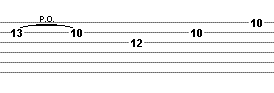
If each of these notes is played as a sixteenth note, always each fourth of them will fall on the beat. As there are five different notes over a rhythm of four sixteenth notes, the first note of a sixteenth group will always be different, see the following tab.
 After 20 notes, which is on the 2nd beat in the 2nd bar, the notes will repeat, after 80 notes which is after 5 bars, the first c note will be on the “one” again.
Simple but clever, isn’t it? Often the simple ideas are the best anyway. However, if you try to play the lick, you will find that it is everything but easy to play. Since always the first note of a group of four sixteenth notes is stressed, you have to stress a different note all the time (always the one on your foottap of course). Sometimes you even have to stress the pulled-off note. It is hard not to lose the musical context, in other words not to lose where you are in the chord scheme (which is basically Dm, Dm7, G , D by the way).
Here is the video that shows what I am talking about. Unfortunately specifying a starting point seems not to work any longer in embedded youtube videos, so you manually need to go to where the lick is, which is ca. between 6:52 and 6:57. I will also try to record a tutorial video on this lick as soon as I will find some time. Happy practicing!
Related articles

4 thoughts on “Interesting lick in Telegraph Road from a 1992 live version”
Just tried it out and you’re right, it is harder than it seems at first! And due to the rhythm it doesn’t really sound like you’re just playing the same notes over and over again. Very interesting find indeed Ingo, please more of this!
I wonder if he thought of that earlier at some point or if he just came up with it on the spot…
Cool lick – you might be over-analysing it a bit though Ingo, I don’t think MK was thinking about it as deeply as you, but you do seem to have a very analytical mind! 😉
Hmm, difficult to say whether I am over-analyzing or not (did I mention that I am a maths teacher? 😉
I personally tend to think that such licks do not come out randomly (especially at such a high tempo) but need to be understood and practiced slowly. Of course, as soon as you mastered one lick of this pattern, you can easily vary it and invent new licks on the fly.
And it seems he exchanged licks a lot with Paul Franklin at that time.
Big fan of the work Ringo,
As a person who is also very analytical this seems to work perfect for me. Though I’m still trying too understand how Mark plays what are the songs in your opinion the best too start and get a hang of the style. I do play with my fingers as a clawhammer any suggestions?
Maybe some more beginner lessons 🙂 there’s a lot of advanced stuff which I really want to get into but I need to get the basics first of his style.
My overall skills is above medium I can figure out by ear I know my pentatonics and arrpeggios etc just now getting in to the style
Keep up the good work man! I will buy you a beer hehe