Pages

Blog Post Categories

Archives

Recent Forum Posts

Recent Comments

Links

Meta

Support this Site

Buying things through the links below cost you no more but helps to keep this site alive! Thanks, Ingo

Thomann is Europe's biggest warehouse for musical instruments with low prices.

Musikhaus Thomann Linkpartner

logo125x125button

Click on the banner for a list of downloadable tabs & sheet music for "Knopfler" at musicnotes:

icon icon

Make sure to use the correct Amazon for your country (US / UK / Germany)

Bookmark and Share

Tag cloud


  • Featured Amazon product


    Make sure to visit the correct Amazon for your country (UK / Germany / US):


    With this article,  I want to feature my good old acoustic guitar: a Gibson MK-81 from 1976.

    I got this guitar more than 20 years ago. I was looking for an acoustic guitar and was trying out all the guitars in that shop. After a while the shop owner brought one more from some room in the back,  saying I should try out this one, it was special. This was the Gibson MK-81, and in fact it sounded different from all the other guitars, it sounded more ‘expensive’ in a way, with a warm bass and brilliant treble, like a great HIFI speaker compared with a cheap one. He told me that this guitar had been damaged damage and was not professionally repaired (the bridge had solved from the top and had been glued back to its position, additionally fixed with two screws), and that it normally costs more than 3 times the money I wanted to spend.
    Well, we agreed on a deal (I had to part from a nice Tokai Telecaster copy I had back then) and I took this guitar home with me. The damage could be repaired professionally for about 100,- € by the way.

    The MK series

    I had never heard about these guitars before, and there was not much information available. Remember, this was before the Internet, so you had to look through guitar books at the shop when searching for a particular information. Today it is so much easier. The story behind the Mark series seems to be like this:

    In May of `73 Gibson began the Mark story by contacting Dr. Adrian Houtsma, Professor of Acoustic Physics at MIT, to confirm some research Gibson itself had initiated. Receiving a favorable review, Gibson then went to Dr. Kasha, who was at the time, a chemical physicist working as Director of the Institute of Molecular Biophysics at Florida State University. Combining the findings from Gibson` R&D department and Drs. Houtsma and Kasha, the company finally landed on the doorstep of well known luthier Richard Schneider, who was charged with making the scientific information practical, designing a guitar that fit with Gibson`s aesthetics and capable of being put into production. The Mark series was born…

    The Mark series was no commercial success, rather the contrary as it seems. It turned out that science alone was not capable of building perfect guitars made of wood, a material that is unpredictable  because each piece of wood has individual features. After only 3 or 4 years Gibson dropped the Mark series again.

    But these guitars were not really bad, and I heard from many owners how much they love their MK’s. The complete series consisted of 5 models, the MK 35, the MK 53, the MK 72, the MK 81, and the MK 99 (the higher the model number, the better the materials, and the higher the price).

    Here is a page from a Gibson catalogue from that time that shows the different features of the different models:

    The MK-81

    Both the rim and back of my MK-81 are made of solid (!) rosewood (possibly Brazilian, but not sure), the top is solid spruce. The neck is curly maple, the fingerboard is ebony with mother-of-pearl inlays. There are some fancy details that make sure that this was the top-model of the production range (in fact, the MK-99 seems to be custom-made by luthier Richard Schneider himself only) like  the gold plated hardware or the black and red bindings.

    It is a special guitar in fact. It is very deep, and the body and headstock shape looks somewhat unusual. The sound is warm and bright, a bit bell-like. With the heavy Gibson jumbo frets and the “fast” neck shape it plays almost like an electric.

    Pictures of my MK 81

    The soundhole ring looks like wood but is plastic

    Note the red bindings

    Ebony fingerboard with mother-of-pearl block inlays

    The sides and the back are solid rosewood (probably Brazilian)

    Youtube videos

    Two of my latest youtube videos feature this guitar.

    If you want the full story and more details of the Mark series, see this article in vintage guitar magazine.

    "Buy me a beer" - Most people take it for granted to get top-quality content for free. Advertizing income covers less than 10% of the work I put into the site, so why not say thank you with a PayPal donation?

    Related articles


    Mark Knopfler owns two beautiful vintage Gibson acoustic guitars which he seems to play a lot on his studio albums these days. One is a 1953 Gibson Southerner Jumbo, the other a 1938 Gibson Advanced Jumbo which I would like to feature in this article.

    The 1953 Gibson Southerner Jumbo is the acoustic guitar in the centre, the 1938 Advanced Jumbo the one on the right side

    The 1953 Gibson Southerner Jumbo is the acoustic guitar in the centre, the 1938 Advanced Jumbo is the one on the right side (picture courtesy Guy Fletcher)

    Both have a sunburst finish and thus look a bit similar at first glance. Besides the different body shape, the different fingerboard inlays tell you the model when you see Knopfler playing one of these on any pictures or videos. While the 1953 has double parallelogram pearl fingerboard inlays, the 1938 has the so-called diamond and arrowhead inlays.

    Left: parallelogram inlays on the 1953 Southerner Jumbo, diamond and arrowhead inlays on the 1938 Advanced (right)

    Left: parallelogram inlays on the 1953 Southerner Jumbo, diamond and arrowhead inlays on the 1938 Advanced (right)

    The Advanced Jumbo was only produced this way from 1935 to 1940 (but was reintroduced in 1990) , and only about 300 of these were made. It was the top of Gibson’s acoustic guitar line back then. The neck has a slimmer shape than on some other Gibson models. Maybe for this reason Knopfler prefers it for playing licks and different stuff on it, and possibly rather uses the 1953 for strumming.

    The back and sides are of rosewood, while the neck is mahagony. The Advanced Jumbo was only available in sunburst, note that guitars from before 1938 had less yellow than the 1938 on the following pictures (courtesy provide.net/~cfh/).

    gibson-advanced-jumbo

    If you want to learn more about all special features and specs of this guitar, I recommend this great site.

    I played a few old Gibsons but not an Advanced Jumbo, but all I played sounded great, sometimes even “too good to be true” (like an 1958 LG-1, which I could not afford at a price of about 1,400 € in the early 90ies, wish I had sold whatever back then and would own the best acoustic I heard now). So I can imagine that Knopfler’s Advanced Jumbo is a great sounding guitar, something way beyond the stuff we normal mortals come along.

    You can watch and hear Knopfler playing it on this BBC video:

    Or watch this guy on youtube playing another 1938 AJ:

    I am still dreaming of buying one of these on the next flea market for a few bucks (dream on, Ingo…)

    "Buy me a beer" - Most people take it for granted to get top-quality content for free. Advertizing income covers less than 10% of the work I put into the site, so why not say thank you with a PayPal donation?

    Related articles


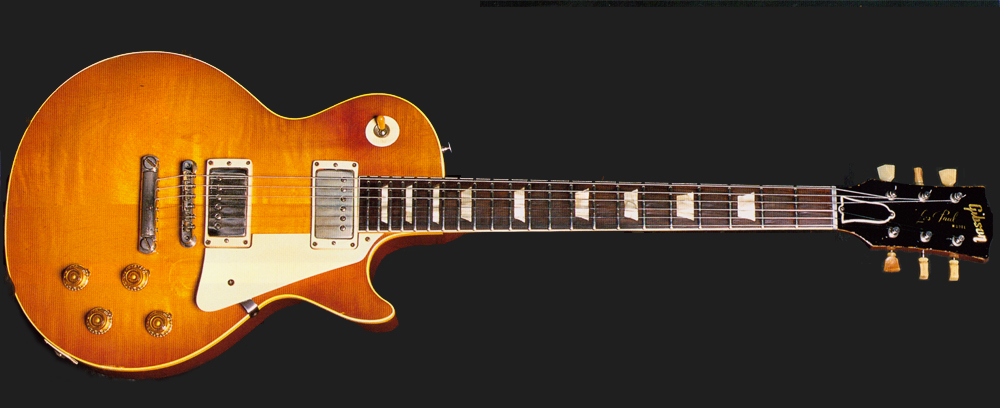
    Have you ever wondered why Mark Knopfler’s Gibson Les Pauls (he has a ‘58, a ‘59, and some replicas of late 50ies models) differ so much in their colour? And what is the colour called, simply sunburst, or is it cherry sunburst, or tobacco sunburst? Have you ever heard the term ‘unburst’?

    from left to right: Knopfler's '59 Les Paul Standard, a reissue, the '58

    The answer is simple: all those Les Paul Standards from that era (they were only built in this version from ‘58 to ‘60) were cherry sunburst, a sunburst which goes from red on the outer area to yellow in the center. However, the red paint Gibson used in those days was very sensitive to light exposure (especially UV radiation) and easily faded. This is a general problem of red, but it depends of the kind of laquer to which extend this might happen. Modern laquer is almost stable in this respect, but the laquer on the early Les Pauls has proven to be extremely sensitive, much more than the one of Fenders from that time.
    While there are old Les Pauls Standards that look like new – which means a bright red -, there are others which have lost all the red and seem to be completely yellow. These got the nickname ‘unburst’ – Peter Green’s Les Paul from the Fleetwood Mac days (later this guitar belong to Gary Moore who meanwhile sold it) is maybe the most famous example of these.

    Peter Green's Les Paul Standard - all red faded, an 'unburst'

    Peter Green's Les Paul - all red totally faded, an 'unburst'

    "Buy me a beer" - Most people take it for granted to get top-quality content for free. Advertizing income covers less than 10% of the work I put into the site, so why not say thank you with a PayPal donation?

    Related articles