What is the Circle of Fifths and what do I need it for?
Every guitar player pretty soon realizes that certain chords seem to belong together, they are related in a way, while other chords are only rarely used within the same song. The chords C , F, and G seem to be such related chords – these are not only the chords you would use for a blues tune in C, but also the majority of traditionals – if you play them in the key of C – do not require any other chords than these three.
So, how do I know which chords are related, which ones are even closely related, which ones are not?
The answer can be found from a simple chart that is called the “Circle of Fifths”. I will simply skip all the redundant information like “why a circle, why fifths – or sometimes even ‘fifths and fourths'”, instead let’s only look at some practical use it can have. More theoretical information can be found at countless places, e.g. here the Wikipedia link.
Here is the chart (taken courtesy from library. thinkquest.org), read on how it works:
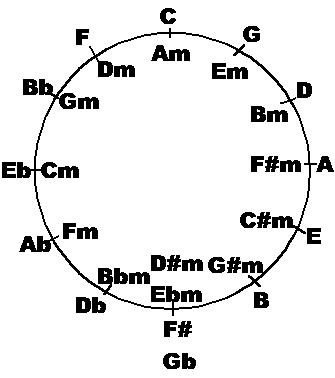
To keep it really simple: Outside the circle you will find major chords, insides are minor chords. Each major chord has a corresponding minor chord (e.g. Am belongs to C, C#m to E, ..).
Rule 1: The closer the chords are in this circle, the more they are related !
For example, we have a song in the key of C. The right neighbour is G, the left is F. –> F and G belong to C (the right neighbour is the so-called dominant chord, the left one the sub-dominant chord).
Let’s add some minor chords: Am belongs to C, Dm to F, and Em to G. –> We get the chords C, F, G, Am, Dm, Em.
On the other hand, a C#m would be very far away from our C, so it is not related, does for this reason not appear in many congs in C, and would sound rather ‘strange’, or at least ‘surprising’.
Only one additional rule:
Rule 2: In a minor key, the left and right minor neighbour chords (in the key of Am, these would be Dm and Em) can also appear as a major chord (D or E).
So, a song in Am might not only have chords like C, F, G, or Dm, but also D and E.
That’s all you need to know, easy, isn’t it?
Now, what do I need it for? Well, to write your own songs (make it sound ‘normal’, or deliberately use strange chords, as you want) , or to figure out the chords of a new song you want to learn by ear: as soon as you have the first chord, try to find the other ones by trying out neighbour chords, often these are the ones you are looking for.
Enough theory, here are some examples:
Example 1: Sultans of Swing
The key is Dm. All chords of the song: Dm, C, Bb, F, and A.
See the next picture: all the chords are pretty close, only the A (right side) does not fit in. If you apply rule 2 (the Am can be replaced by A), everything is in place again, all the chords are “one family”.
(Note: some of the long live versions also have a Gm and Am chord, I left these out, but note how these would also fit in).
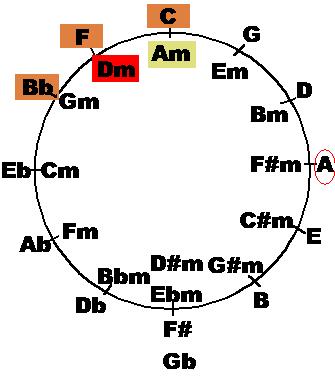
(some of the long live versions also have a Gm and Am chord, I left these out, but note how these would also fit in).
Example 2: True love will never fade
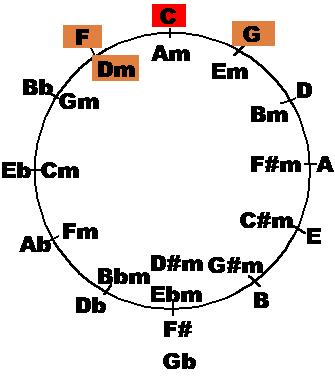
The key is C, all chords are: C, F, G, Dm
They are all related and thus very close in the circle of fifths, see below:
Example 3: Money for Nothing
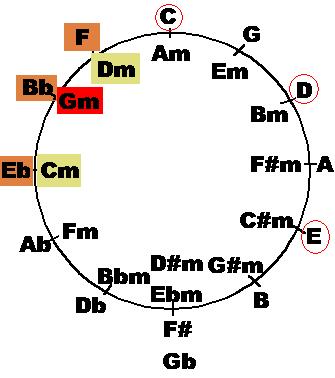
The key is Gm, all chords are: Gm, Bb, F, Eb, C, D, and E.
The C, D, and E chords seem to be out of place (see below), the C and D can be understood as replacements for a Dm and Cm chord (rule 2) and do thus fit into the pattern, while the E is completely out. In fact, this chord sounds somewhat unexpected (it is the last chord of each refrain, on “color TViii-iiih”), especiall the following change back to Gm is very unusual and thus adds some extra kick.
Alright, that’s for today. You should use use the comment function (no registration or email required) to let me know if this article was helpful, or to ask questions, or to make suggestions.
CU soon here again,
Ingo
Related articles

28 thoughts on “The Circle of Fifths: What is it for? – plus: example analysis of Knopfler songs”
Cool, first time I understand this, Very helpfull, thanks
Ingo, great article. I knew most of this, but the substitution of a major chord where a minor one would normally be was a bit of an “ah ha” moment for me. I’ve seen this in many songs, but it never dawned on me that there as a “formula” to it.
John, nice to see you liked the article.
The reason why this substitution works (e.g. D instead of Dm, or E instad of Em, both in a song in Am) has to do with the different kinds of minor scales:
the “natural” minor scale of Am has the same notes like the C scale : a, b, c, d, e, f, g,
the “harmonic” minor scale has a g# instead of g
–> and thus an E major chord (e , g#, b) instead of Em (e, g, b)
the “melodic” scale also has the g#, and a f# instead of f
–> and thus a D chord (d , f#, a) instead Dm (d, f, a)
more on these minor scale in the Wikipedia at: http://en.wikipedia.org/wiki/Minor_scale
Also note that Mark often uses both chords within the same song: example Six Blade Knife, the part in the middle (I’d like to be free of it now) has the chords : Dm, C, G, D, so both Dm and D, it changes between two minor scales and so creates a typical effect
Love your explanation!!! Please let me read more!!!!!!!!
Great information.Learning guitar chords are one of the first steps to great guitar playing. We will be surprised how many different songs we will be able to play just by mastering a few simple guitar chords. By learning the G, C, D, A and E chords we will be able to play a lot of popular music. Learning guitar chords are one of the secrets to playing real music.
Hey guitar dude, thanks a bunch i never had it explain to me like that before and now i get it. i really apprecite how well that was explain and so easy to understand. Do you have any site which i can go to where it teaches someone learning lead guitlikes that knows all scales but when i try to play lead it sounds like i am just playing scales and i feel stuck in the box . is it that i just dont have the lead mentality or what . friends think i am good but they dont know i am playing scales all over the neck but i know the truth and i feel stuck can you help or show me a video that will break this boxy lead i have.
Tony
Great explanation! I’ve seen the circle before, but never with a description on how to put it to use. I’m new to your site, keep up the good work!
P.S. I’m in Canada and I play an early 80’s Tokai(with new Fender pu’s) through an early 1980 Hiwatt Custom 50, so I’m rockin’ all over the world!
Thank you for your comment. As you play a Tokai you might be interested in the articles about Tokais and other Japanes vintage guitars. You will find these 4 articles following:
http://www.mk-guitar.com/tag/japanese-vintage/
hey..thanks a tonne..this is great!
great job! I´m working on this circle, it´s very useful to understand musical theory, I´ve seen it before but I cannot understand a thing, with your great explanation now I´m able to learn it.
i stumbled on this webpage, ive been playing guitar for about 5 years nothing to serious tho, everything by ear or tabs, i can play, but to ask me hat im playng i have no idea.. so ive recently started lesson, to try and understand some of the theory behind what im playing,
some makes sense, some just goes over my head.. i found your teaching style very easy to get and i thank you for that, now i have a better understanding about what SHOULD go togther and what i should try and avoid haha
thanks heaps mate
if you have any other poast mate, can you let me know, as im very keen to learn
chinz__@hotmail.com, thats with 2 underscores
cheers
Play guitar fast!
Just to let you know that you have cleared up my confusion in minutes that I have been truing to understand for days.
I really appreciate the help.
Just read your circle of fifths – brilliant. Started guitar theory lessons and we are looking at sultans. I wanted to know how come the A chord fits – having read your article i now know. Many thanks
Very cool stuff. I love simple truths like this, and really feel like I took another mini-leap forward. I also realized that Google Images is an awesome place to search for guitar chord graphics!
Hi, Ingo! You explained it perfectly, I think. I’ve had some trouble getting into the whole circle of fifths concept (I only learned it about six months ago), but your explanation helped a lot. I have played the piano for almost seven years now, and I recently started learning the guitar – acoustic, at the moment, but I’m hoping that electric will come soon too – and I stumbled upon your site while searching for some MK guitar stuff on Google (big fan of his).
Keep it coming!
where do 7th chords come in this? do you just substitute a major chord for a major 7th and minor chords for minor 7ths?
Often the seventh chord is used as the dominat chord (the right-hand neighbour in the circle), like e.g. C – F – G7 for the key of C, but with rock or pop music I found it is more like you suggested, they are used when their sound fits in.
Very good explanation – especially like the examples. It’s helpful to know “why” one should learn this…
oops – forgot the “thanks for posting” part…
Just writing to say many thanks for the above explanation….. really raised my understanding level by a few levels…..your explanation made a lot of the fog go away….. johnnym
Greetings! Very helpful advice in this particular post!
It’s the little changes that will make the largest changes. Thanks a lot for sharing!
I think i get this.. being a bit dim atm. xD
This is fantastic explanation. You simply put everything into one chart which explains entire logic very clear. Thanks!
This is the article that finally made me understand what the circle of fifths is. I will be always grateful to you for such clarity of explanation. God bless you! – Pappa Joseph : pappajoseph.com, worlddailybread.com