
Blog Post Categories

Pages

Recent Forum Posts

Recent Comments

Archives

Links

Meta

Latest updates and news


Tag cloud


  • TOP 15 Popular Articles


  • Top Comment Authors

    • Ingo (370)
    • Jean-François (146)
    • Jeff - Anthony (36)
    • Erik (30)
    • Dermot O'Reilly (28)
    • Fletch (26)
    • TheWizzard29 (22)
    • zach (22)
    • Knopfleberg (20)
    • Philipp (19)
    • Morten (17)
    • John (16)
    • Eduard (14)
    • danny (13)
    • J.Francois (13)
    • Jim (13)
    • Alex Mircica (12)
    • thomas (12)
    • Ryan T. (11)
    • liftedcj7on44s (10)
    • Arthur Luz (9)
    • Chris (9)
    • dave (9)
    • Jakehadlee (9)
    • Jeff - A (9)


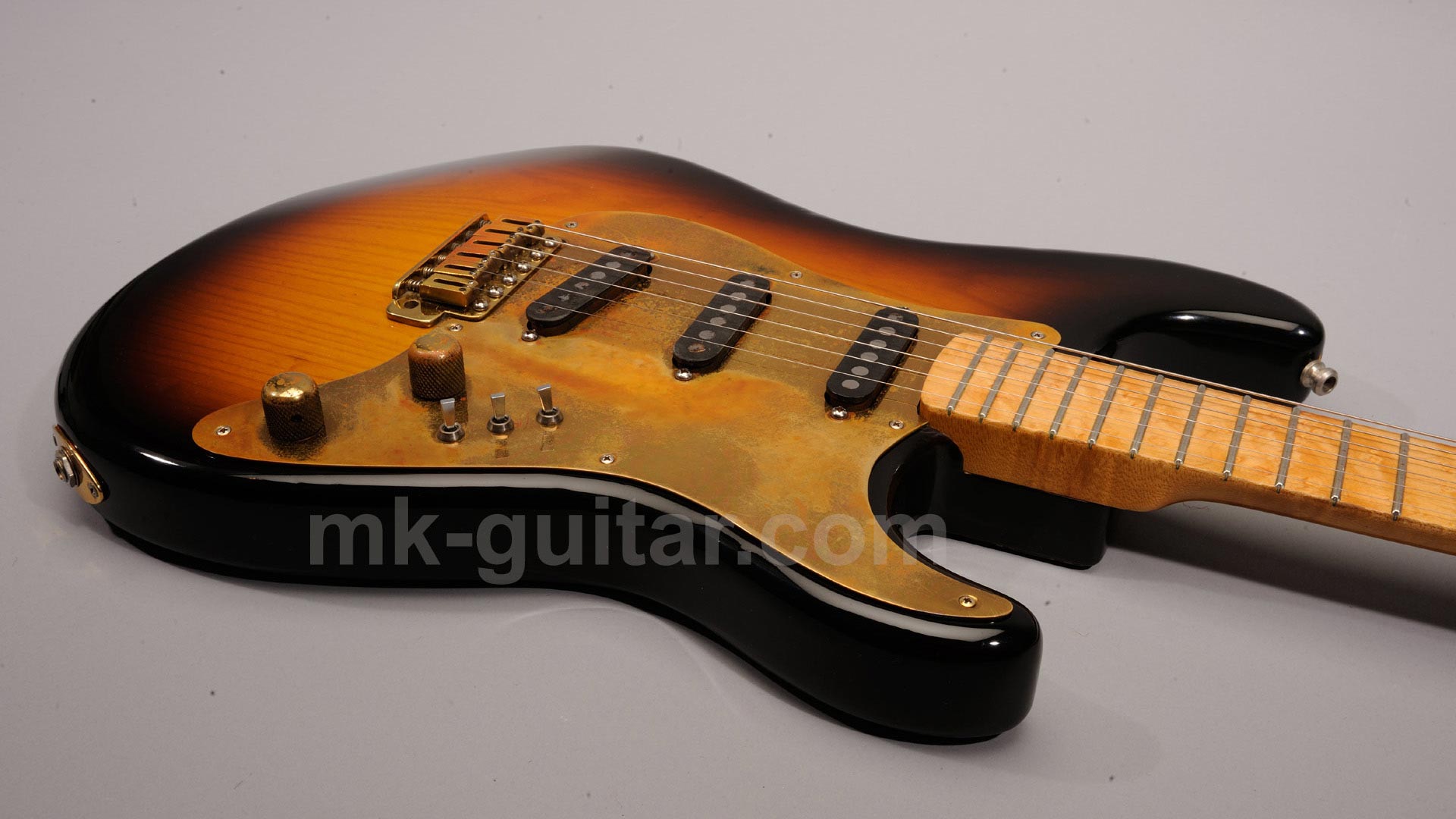
    This blog post is about the next step in my Tele Dream Machine project – the wiring of all controls. The main difference to a standard Fender Telecaster wiring is due to the tapped Walk of Life pickups (or Schecter F521T / F520T in the original)

    Unfortunately the original Omni Pots, those square conductive-plastic potis with the push-pull switch that Schecter used in the Van Nuys era, are no longer available. These were made by Allen Bradley – who are out of business for a long time – or by Bourns who also dropped these from their product range. The only alternative are standard push-pull potis. You can get these here in my online shop, also from Bourns by the way.

    Generally, the original Schecter wiring is like the standard Tele wiring – with exception of some different component values and the Omni Pots that were required to switch the tapped pickups between their normal and the fatter sound. The potis had a 500k value, something that seems a bit unusual for a Tele (Fender first had 250k and later 1 M). 500k seems to be a good compromise for both the normal and the full coil of the tapped pickups.

    The tone cap was a 0.01uF ceramic disk cap. This value is much smaller than the Fender standard (0.05 uF) and also than the 0.02 uF normally used  in the Schecter Strats. When rolling back the tone control, the smaller value results in a more nasal midrange tone instead of the usual dull sound. Schecter used a 680 pF treble bleed cap with a 150k resistor in parallel on the volume poti (Fender standard: 0.001 uF = 1000 pF and no resistor).  The resistor changes the taper of the poti.

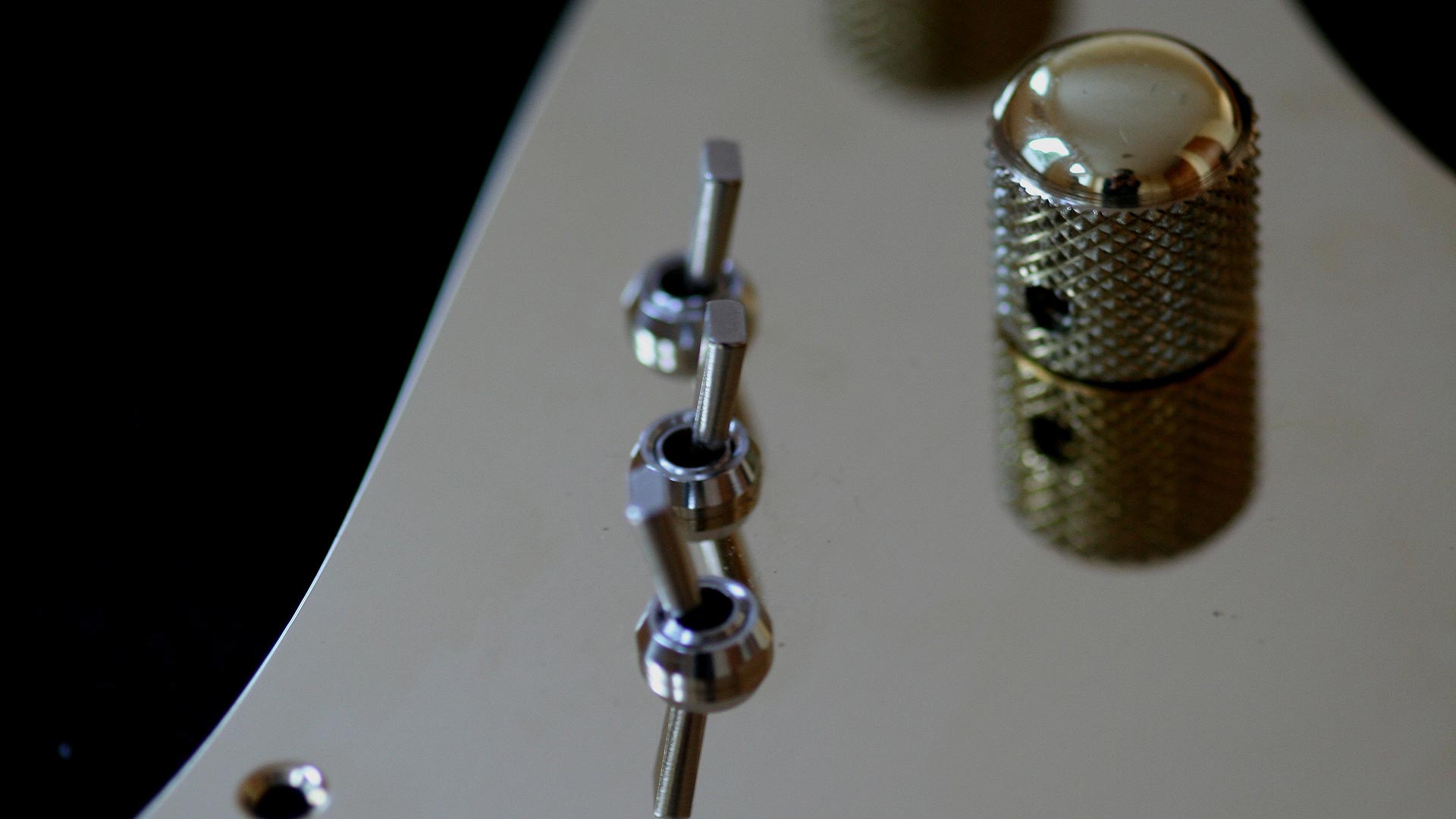
    One problem is that normally all ground wires of a Fender Telecaster are soldered on the back of the potis. This was not possible with the Omni Pots, and is neither ideal with a standard push-pull poti. Schecters solution was to use a small brass soldering plate that was hold by the two potis. All ground wires were soldered to one point on this plate then. As an alternative to cutting such a plate from a metal foil, you can use two washers with ground lugs, and connected all ground wires to these instead (see photo below).

    8 different pickup combinations on a Tele

    Operation is like on any Tele, with exception of the push-pull potis. Pulling out the VOL poti enables a beefier sound on the neck pickup, while pulling out the TONE poti does the same trick for the bridge pickup. This way you can get 8 different sounds of the two pickups instead of 3 sounds on Fenders (n, b, n+b, N, B, N+B, N+b, n+B, with small letters for the normal and capitals for the fatter sound).

    Here is a schematic:

    (3-way connected in Schecter style)

    3-way connected in Schecter style (click to enlarge)

    Alternatively, the 3-way switch can be connected like this (Fender style), the result isthe same:

    (3-way Fender style)

    3-way connected in Fender style (click to enlarge)

    The wiring on the two push-pull potis is shown in a separate drawing here:

    push-pull diagram

    Wiring the two push-pull potis. The one on the VOL poti switches the neck PU, the one on the TONE poti the bridge PU. (click to enlarge)

    The following picture shows how you can use two washers with soldering lugs (included with my push-pull potis) instead of the brass ground plate that Schecter used.

    Soldering all ground wires to washers with soldering lugs

    Soldering all ground wires (black) to washers with soldering lugs

    "Buy me a beer" - donate for the site via PayPal. Or buy a backing track in my online shop :)

    Related articles


    Mark’s Privateering tour has started, and they played the first 8 concerts around south-east Europe and Italy. One song that has been played on some of these  – compared to previous tours they vary the setlist a lot – is Gator Blood. I saw the picture of Mark with the white Strat – it seems to be the 1964 of Sailing to Philadelphia – some days ago and was wondering on which song it was played. The capo at the 3rd fret and the bottle neck are a hint of course, but I did not associate it with Gator Blood. In fact the sound of the album version is different from a typical Strat sound, maybe he played his Danelectro on the album, his main axe for bottle neck these days.

    Here are some youtube videos showing Gator Blood. The tuning is open G (D – G – D – G – B -D), capoed at the 3rd fret (key of Bb). Mark played a similar picking 34 years ago on a song called Do right unto others on Bob Dylan’s Slow Train Coming album by the way. Enjoy!

    "Buy me a beer" - donate for the site via PayPal. Or buy a backing track in my online shop :)

    Related articles


    I recently watched this video on youtube and felt to share it with all readers of my blog. It shows Abigail Ybarra winding a pickup in the Fender custom shop. In case you haven’t heard of her, she started to wind pickups at the Fender factory in 1956, and again does so at the Fender custom shop today. She is the mother of pickup winding so-to-say.


    The youtube video shows you what is meant with hand-winding a pickup, or scatter winding. Of course noone wounds a pickup by hand in the sense of laying single turns of thin wire around the coil, and neither by turning the coil by hand. For this always machine have been used, but the wire is led by hand. This way the person who operates the machine controls where exactly the next layer of wire goes, and also the tension of the wire.

    Scatter winding means all the time the wire is  led from one side of the bobbin to the other, and back again. Such details are of importance for the sound of a pickup because they affect physical values, e.g. the capacity of the pickup. It is a mistake to think only the number of turns and the material of the magnets matter, it is much more. Even the insulation of the pickup wire – normally something like enamel or a material called Formvar – is of  importance, and both the thickness of the insulation and the material cause clearly audible differences. Of course it is still all physics and not vodoo, but a pickups is really a highly complex issue.

    "Buy me a beer" - donate for the site via PayPal. Or buy a backing track in my online shop :)

    Related articles


    Building a Telecaster Dream Machine – Part 2

    Posted in: Guitars by Ingo on April 23, 2013


    After the Walk of Life pickups – a  reproduction of the Schecter F520T / F521T sound – are availabable now, I can continue with the next steps of my Dream Machine Tele project (see part 1 here). I meanwhile found a vintage Schecter brass Tele bridge some weeks ago, so – with my own highly-ploshed brass Tele pickguards  – I have nearly all essential parts for one guitar together now.

    This is the body which I found on ebay some weeks ago. It is one-piece mahogany, not sure which (Honduras, Khaya,...) but it seems nice anyway. Here I put in the two pickups for a picture.

    This is the body which I found on ebay some weeks ago. It is one-piece mahogany, not sure which (Honduras, Khaya,…) but it seems nice anyway. Here I put in the two pickups for a picture.


    Here I installed the brass pickguard. I used the Schecter-style version with only 5 screws, and the pickup is attached to the pickguard (instead of directly to the body just like in a Fender)

    Here I installed the brass pickguard. I used the Schecter-style version with only 5 screws, and the pickup is attached to the pickguard (instead of directly to the body just like in a Fender)

    The face plate is black on this old Schecter neck. The plastic nut and the silver butterfly stringholder do not seem to be original and must be replaced with brass parts (which I don't have yet). One problem are the tuner holes which are too big for Kluson-style tuners (they are correct for Schaller tuners)

    The face plate is black on this old Schecter neck. The plastic nut and the silver butterfly stringholder do not seem to be original and must be replaced with brass parts (which I don’t have yet). One problem are the tuner holes which are too big for Kluson-style tuners (they are correct for Schaller tuners)

    Original would be Kluson Deluxe tuners but I will install a set of Japanese gold-plated Kluson-style tuners. These work fine, and originals are hard to get and more expensive. Schaller tuners are no option for me as I love the Kluson way to put the end of a string into the tuner and bend it into the tuner slot.

    Here is my solution: I wrapped the tuner ferrules with self-adhesive copper foil until they fit nicely into the oversozed holes. 3 to 4 inches were enough.

    Here is my solution: I wrapped the tuner ferrules with self-adhesive copper foil until they fit nicely into the oversized holes. 3 to 4 inches were enough.


    Nice, problem solved.

    Nice, problem solved.

    Tuners installed

    Tuners installed


    To be continued soon…

    "Buy me a beer" - donate for the site via PayPal. Or buy a backing track in my online shop :)

    Related articles


    I reported about the increasing problems concerning guitars with Brazilian rosewood (used e.g. for fingerboards on vintage Fender or Gibson guitars) last year (see here). As a consequence of this, Germany’s biggest vintage guitar  show last November was cancelled, as the CITES restriction does not allow to display a guitar with parts of Brazilian rosewood in public without a special licence.

    With this short blog post I just want you to inform that in fact at this year’s Frankfurt Music Fair (the biggest trade fair for musical instruments worldwide) no vintage guitars were displayed at all for this reason. Last year there was a special display area with lots of vintage Fenders and Gibsons (see this blog post), like Strats from the 50ies and 60ies, even 50ies “bursts” (Les Pauls from 1958-1960) . The only exception was one booth by No. 1 Guitar Center from Hamburg, Germany, who had some old Fenders – but all with the required papers directly next to each guitar.

    Last year you could see lots of vintage guitars-  not this year

    Last year you could see lots of vintage guitars at the Frankfurt Music Fair – not this year

    This shows that the  EU law is really repected meanwhile. It is almost impossible to sell or even display a vintage guitar with the protected Brazilian rosewood – unless you have the proper papers for it. And as this is an EU-wide law (to be correct, even a world-wide law), it will soon be similar in all other European countries soon (German authorities are often said to be more correct than others so no wonder they made the start).

    I also phoned the authorities office for my town to inquire how to get such CITES papers. I will keep you updated after getting these, hopefully soon.


    "Buy me a beer" - donate for the site via PayPal. Or buy a backing track in my online shop :)

    Related articles


    Older Posts »