From now on you can buy the Hotcake overdrive pedal in our online shop. This is the overdrive pedal that Mark Knopfler used on his 2005 Shangri-La tour, and probably on other occasions as well. The Hotcake is built by Paul Crowther in New Zealand since 1976. It has a best reputation among players around the world – Stevie Ray Vaughn also played one.
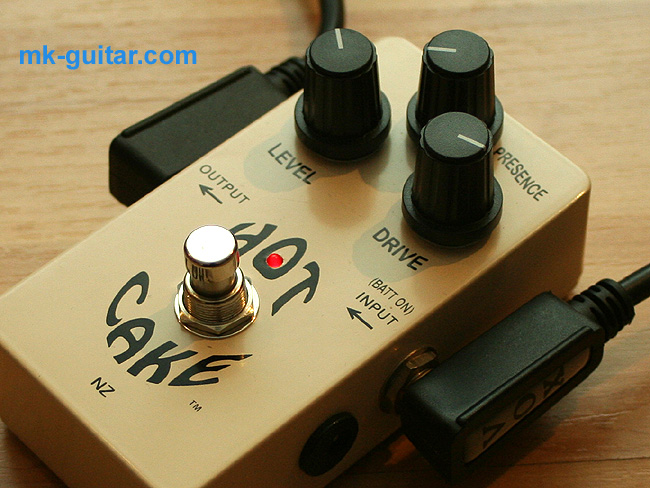
For us Mark Knopfler fans it is obvious that it can only be good – why else should Mark, who can surely afford any pedal in the world, have chosen the Hotcake? In very short, it IS good because (a) it sounds good and (b) it is a high-quality product, made of best component. It is reliable, has a low noise floor, and is very stable.
What I really like about it is that it does not alter your clean sound, unlike other overdrive units that even with minimum (or no) distortion totally change your tone. With the drive control down, the Hotcake is totally clean, and your sound is identical to what it is without. For this reason it is also ideal to boost your guitar signal to get more drive from a tube amp.
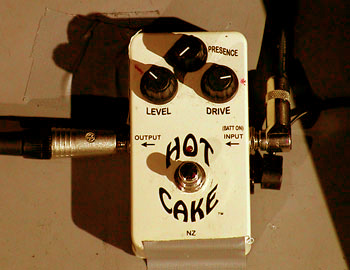
When you turn up the drive control you get any desired amount of distortion, starting with a subtle crunch, over a creamy overdrive (picture 4 shows Knopfler’s setting for the song Boom like that), to a fat and thick distortion. In fact even with a single coil guitar and the drive at maximum you get much more distortion than with typical tube screamers.
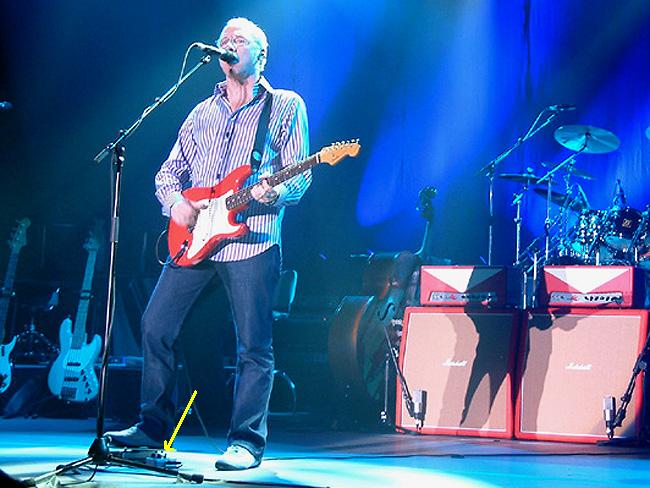
The sound is really as you hear e.g. on the 2005 tour, just listen to the crunch of Mark’s Silvertone guitar on Boom like that. I will try to make some sound clips or a demo video soon.
Check it out in the online shop
Related articles

6 thoughts on “The Hotcake overdrive pedal”
Ingo, can you explain what is meant by “presence” ? On my Deville Amp also, I never know what to do with this setting, or how it’s affecting the sound …
Keep up your wonderful blog, I’m addicted.
Cheers, Fletch!
Presence basically means a tone control, typically something between mids and treble.
Very late to the party, but anyhow…
Ingo, will you pls let me correct you on “Presence”: Future readers might otherwise be as confused as Dave Fletcher… Here goes:
1. PRESENCE as an AMP-control:
Generally, any guitar-amp has TWO “stages”: The PREamp is the 1st stage, and responsible for SCULPTING your tone – while the POWERamp (2nd stage) amplifies your sculpted signal to the desired VOLUME.
Thus, an amp’s EQ is located in the preamp, and normally in a “subtractive” manner; it is “passive”: When you turn the treble ‘up’ on a Fender or Marshall, you actually DECREASE mid- & bass-frequencies, since a preamp cannot boost – volume is created only in the 2nd amp-stage, remember? [A rare exception is found in e.g. ORANGE amps utilising a “Baxandall”-EQ allowing for both cut & boost (google Mr Baxandall for details).]
Now, presence is like a 2nd seperate EQ-section, located in its poweramp-stage: Here, frequencies are boosted selectively, usually the upper mids & the very highest frequencies (beyond your treble-control). Since this “active” EQ works via increasing the volume of said frequencies, it facilitates pushing the signal for added “presence” in a mix – hence the name presence! You will also note that the control is located close to / in the amp’s “master” (=poweramp) section (e.g. the “cut”-pot on a VOX AC30 is nothing but a presence control).
2. PRESENCE on the Hotcake:
What makes the Hotcake so special, is that it was designed by a bass player – Paul (Crowther) is not an engineer. Thus, his pedal is unique and does not follow electronic convention. The “presence”-switch (or knob on newer models) is a perfect example, as it is a mere mid-boost: Paul noticed, that the more you overdrive a signal into distortion without correcting your EQ, the more bass & treble are boosted, while the mids are relatively “left as they were”… and this lack of mids is resulting in a “muddy” or “mushy” sound. The guitar “lives” in the mid-frequencies of any mix – they create what we call “punch”:
At your next band practice, play with the EQ on your overdriven (solo-)sound: On reducing mids, you will find an immediate, massive (perceived) drop in volume – much more so than reducing treble or bass by that same amount!
Paul noticed this, and consequently integrated a mid-boost into the Hotcake – try turning your “Drive” & “Presence”-knobs to zero, and BINGO!, you have a 100% transparent booster-pedal: No change in your guitar’s sound, just more volume. Now, turn up the “Drive”, and you will “drown” in your band’s mix, as your sound becomes “softer” the more you overdrive the pedal. Bring in the “presence” (mids) now… you will not only hear, but even FEEL how your signal will gain “punch”, until (max. presence) your sound almost jumps “in your face”. BTW that is how Paul imagined the “correct” use of his Hotcake! Moreover, this concept is also the reason why the Hotcake is PERFECT for the normally very soft mids of an AC30…
Long story, I apologise. You know, I still remember how frustrated I was when I got my first Hotcake… it is so totally different from all other overdrives out there, that I just could not get a good sound out of it: For years, I doubted the hype, and even sent my pedal back to Paul (who found it to be 100% OK – of course). Nonetheless, he explained his concept to me… since that day, I find myself playing MUCH cleaner, yet sounding bolder & more powerful than with any other pedal I have ever tried… and if I can help ONE of you out there better understand the Hotcake – and maybe even experience a similar “WHOA!” like I did – then it was worth it!
PEACE. LOVE. ROCK’N ROLL!
I didn’t know if an overdrive pedal would work well with the mid-boost in my strat so I tried out a “real tube” overdrive pedal that my guitar teacher has and I loved the sound that it gave. It was real bluesy so how would this pedal compare to the real tube?
This is the one that he uses to create that sound in Sultans of Swing live of Shangri-la tour?
I didn’t understand, he closes the tone to get that smooth sound?
https://www.youtube.com/watch?v=EnwR63zOO1g