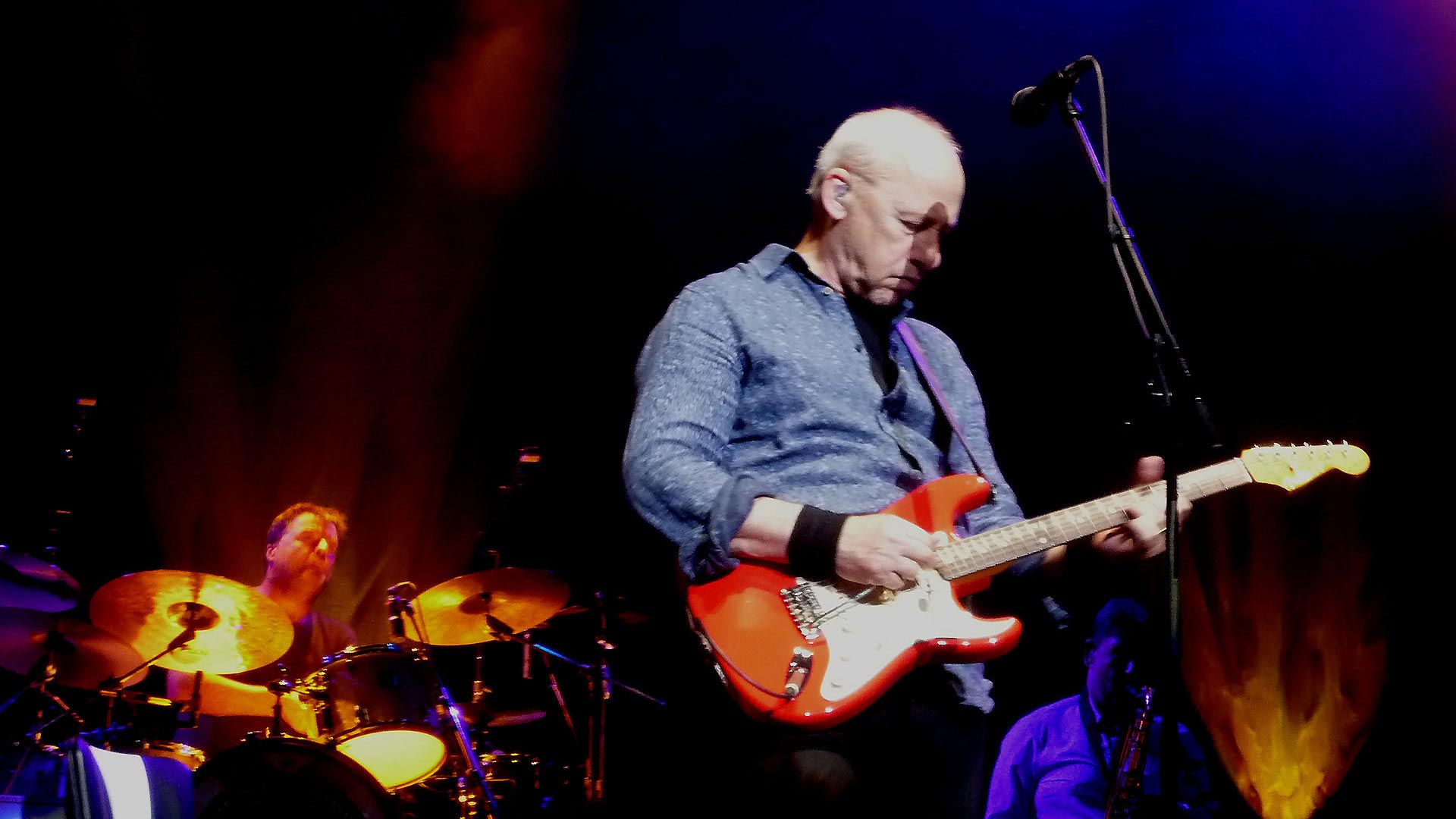
Mark Knopfler licks using the b5 note

The b5 notes means the flattened fifth note of any scale. If we have e.g. a  C-major scale (c – d -e -f -g – a – b – c ), the fifth note is the g , and if this note is flattened, we get the gb. The same logic works with any major or minor (or other) scale.

The following video demonstrates the usage and the position of this note. You will find Mark Knopfler licks from Sultans of Swing (Alchemy version), Calling Elvis, In the Gallery, Down to the Waterline, and many more.

I did not tab these licks here, but I think you will not have problems to see how they are played. Remember, it is not important to play something authentically but rather to understand the idea behind what is being played. Only this way you will be able to transfer the licks into your own repertoire, and to use them for your own music.

The video is in high quality here. If you have bandwidth problems, click here to go to youtube and watch it at standard quality. Enjoy.

50th Article

With this post I am proud to annouce the 50th article of this blog, which went online on August 10, 2008.  50 articles in 104 days means an average of 0.49 article per day, or 3.4 articles every week.

In these three months the blog built up a reputation among Mark Knopfler fans and guitar players, and the number of daily visitors is still steadily rising.

Thanks to every visitor and to all who expressed how much they like this blog. Also thanks to all who commented here, and this way helped to make the blog really interactive.

I really enjoy writing about what I am interested in myself, so be sure that there will be many more articles in the future.

Knopfler goes Jazz – Video with licks from Comfort and Joy soundtrack

In 1982 Dire Straits recorded their Love over Gold album in New York. According to Knopfler himself, he spent some time before with learning new chords and licks from a book by Mickey Baker. This circumstance, and the collaboration with Jazz musicians of the New York jazz scene – like Mike Mainierei, Michael & Randy Brecker or Tony Levin – seem to be the reason why sudenly more jazz elements appeared in his playing.

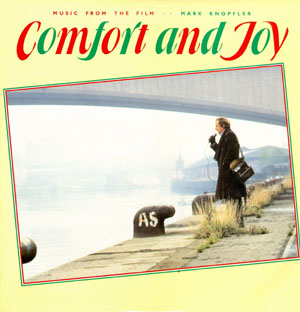
A short time later Knopfler recorded the Local Hero soundtrack, again some of these musicians appeared on tracks like Smooching. In 1984 the soundtrack for Comfort & Joy was released. The licks in the following video are from this 3-track soundtrack – from the track Joy (orginally released on a maxi vinyl single). They illustrate Knopfler’s jazzy approach -typical elements are chromatic notes, e.g. using the b5 note of the scale, or the swing rhythm.

I have not heard the soundtrack for years I must admit, and generally I do not care too much about playing 100% authentically, I rather try to catch the feel and play it the way it sounds good to me, so forgive me if some details are not accurate. Nevertheless the video should give you some insight of what is going on.

Video in high quality: (in case of bandwidth problems, click here to go directly to youtube and watch it at normal quality)

If you don’t know this rather rare soundtrack, you can hear the intro of the song Joy here:


John Illsley’s photo stream on flickr

Today I surfed into some early Dire Straits photos I have never seen before on flickr.com. These belong to – guess who – Dire Straits’ bass player John Illsley. He has his own photo channel there. Check out!

John Illsley’s photo stream

Update: I meanwhile also found a comment from John about these pictures on his great looking site at johnillsely.com:

Dire Staits in 1978
————————————-

Thanks to Henk for sending me photos from 1978 of the Straits in Greenwich, London, standing in the mud after the tide had gone out. You can look at them on our Flickr page.

We were rehearsing at The Wood Wharf Studios for a UK tour at the time, which was a short walk from the flat that me, Mark and David used to share in Deptford. As you can see, food was pretty scarce in those days!

If I remember rightly, some of these pictures ended up in Time Out.

Sunburst and unburst Les Pauls from the late 50ies

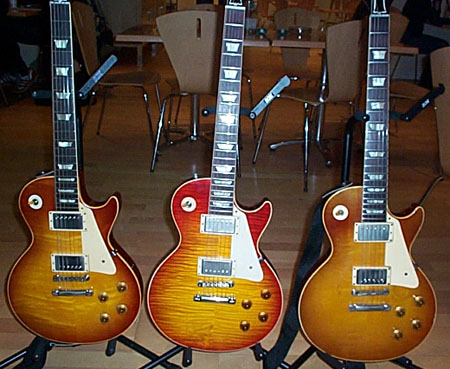
Have you ever wondered why Mark Knopfler’s Gibson Les Pauls (he has a ’58, a ’59, and some replicas of late 50ies models) differ so much in their colour? And what is the colour called, simply sunburst, or is it cherry sunburst, or tobacco sunburst? Have you ever heard the term ‘unburst’?

from left to right: Knopfler's '59 Les Paul Standard, a reissue, the '58

The answer is simple: all those Les Paul Standards from that era (they were only built in this version from ’58 to ’60) were cherry sunburst, a sunburst which goes from red on the outer area to yellow in the center. However, the red paint Gibson used in those days was very sensitive to light exposure (especially UV radiation) and easily faded. This is a general problem of red, but it depends of the kind of laquer to which extend this might happen. Modern laquer is almost stable in this respect, but the laquer on the early Les Pauls has proven to be extremely sensitive, much more than the one of Fenders from that time.
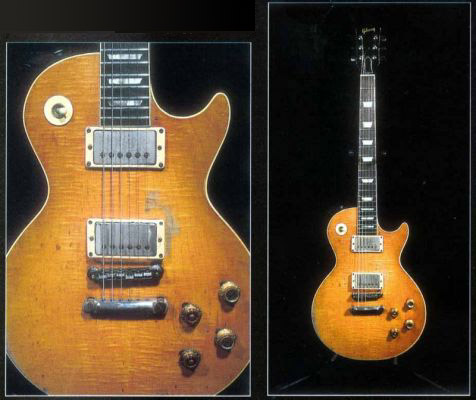
While there are old Les Pauls Standards that look like new – which means a bright red -, there are others which have lost all the red and seem to be completely yellow. These got the nickname ‘unburst’ – Peter Green’s Les Paul from the Fleetwood Mac days (later this guitar belong to Gary Moore who meanwhile sold it) is maybe the most famous example of these.

Peter Green's Les Paul Standard - all red faded, an 'unburst'
Peter Green's Les Paul - all red totally faded, an 'unburst'

Shubb capo for vintage Strats

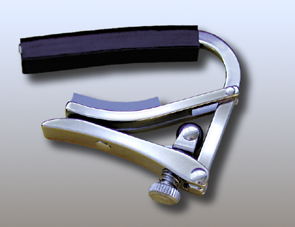
I have been using the great Shubb capo for some years now. I love it because it is not only easy to use, but it also allows you to set the tension on the strings very precisely so that you have hardly any problems with detuning. Of course it is available for curved or flat fingerboards. However, until recently I have not been aware that there is also a special version available for vintage-style Strats or other guitars with a neck radius of 7.25″, the Shubb deluxe S4. And this version is in fact much better on a Strat. The normal version (I guess it is for about 9″ radius) has not enough tension on the outer strings, or you can set it to more tension which results in too much on the inner strings. Unfortunately Shubb capos are not cheap, but they are really worth the money.

Mark Knopfler’s Amp and Effect Settings on the On Every Street tour

A lot of people wonder how to adjust all the controls on the guitar amp or on effect devices to recreate the sound of song xy. Such questions are common in guitar forums all over the internet. Of course it is almost impossible to say which setting someone needs to recreate an authentic sound with his individual gear. Besides, even if you use exactly the same kind of setup with the same setting as on the original song, this does not guarantee to get the same sound because the probably most important sound factor is the playing technique, the old saying “the sound is in his fingers”.
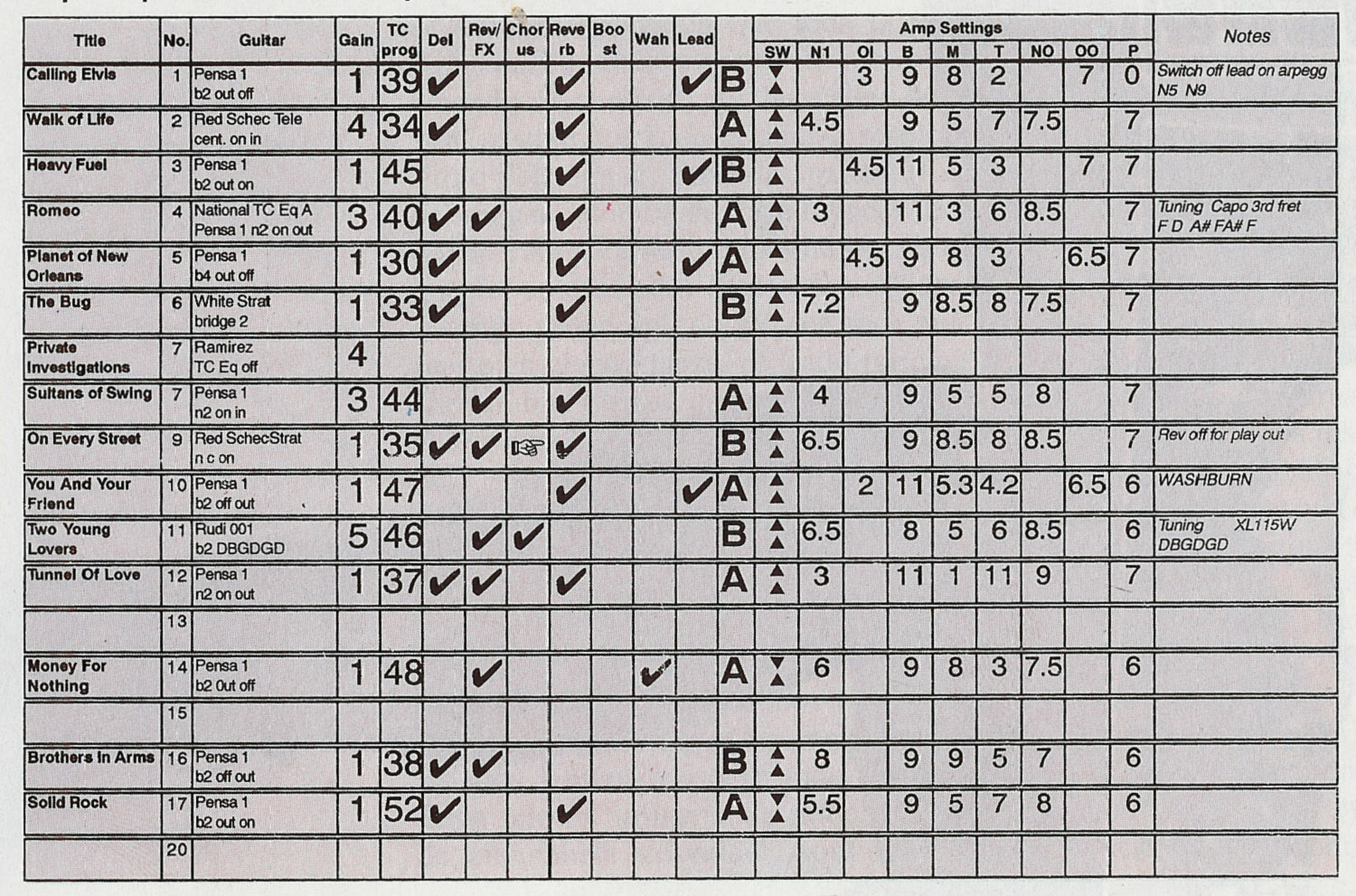
Nevertheless, to know the original setting of a sound can help you to come as close as possible within your playing ability. In the studio, most engineers take photos of amp settings in case a part of the recording has to be fixed with later overdubs, but these pictures almost never get into the public. On Dire Straits’ On Every Street tour (1991/92) however, Mark Knopfler’s then-guitar technician Ron Eve allowed a few interviewers to copy his chart with most settings for the amps and effects. Such a chart appeared in a Mark Knopfler interview in Germany’s Gitarre & Bass magazine, and another one was from the England tour (unfortunately I must admit I downloaded it some years ago but cannot find it anymore).

Ron Eve changed the settings for the two amps and switched between the effect programs for each song. They used two Soldano amps, one is the active amp for a song so that the other amp can be in advance adjusted for the next song. In fact, only the pre-amps are alternated, the power sections of both amps feed a stereo signal into the two Marshall cabinets.

This chart is not really self-explaining, but with some research most parameters can be identified. Here is the chart:

click to enlarge in new window

What exactly do all the columns and figures mean?

Title

The title of the song, nothing to add here except that Tunnel of love was not always played. If not, it was replaced by Telegraph Road.

No.

Just the number of the song.

Guitar

This column does not only list the guitar for the song but also the pick-up combinations or control settings. The denotion of the pick-up combinations is a bit inconsistent: while ‘b2’ seems to be ‘second position from bridge’ = bridge & middle, and ‘n2’ for ‘second position from neck’ = neck & middle, on Planet of New Orleans it says ‘b4’ which might be be ‘fourth position from bridge’ = neck & middle (why not ‘n2’ here ?). On Walk of Life it says ‘cent.’ which is center position (bridge & neck), and on On Every Street ‘n c’ should be ‘neck & center’ (the Schecter Strat has three individual switches, so something like ‘n2’ makes less sense here).

In addition to the pick-up combination we find notes like ‘on’, ‘out’, ‘off’, or ‘in’. On the Pensa these should have to do with the active mid boost (avtivated with a push/pull poti, I guess ‘out’ is on, ‘in’ is off). I am not sure what ‘on’ and ‘in’ might stand for, it seems only the tone control is left as a candidate (?). Please make your suggestions using the comment function.

Gain

This might be the gain setting of the pre-amp in the Cornish rack system that was the container for Knopfler’s 19″ rack effects.

TC prog

The TC was the 2290 delay, these numbers should be  of the program in which they saved the settings for each song

Del

This should be another delay, presumably the Alesis Quadraverb (or it is the Zoom 9010, see Rev/FX). Here we only find ‘checked’ (on) or not. I suspect this effect had a fixed setting and was just switched on for an additional delay effect.

Rev/FX

Maybe the Zoom 9010, or the Alesis Quadraverb, see Del above.

Reverb

The Yamaha REV 5

Wah

The fixed-psoition wah wah (a Dunlop Cry Baby) was only used for Money for Nothing, it was built into the rack.

Lead

Lead (=overdrive) channel of the Soldano amp, if not checked, the normal channel was used, see below.

(Amp)

The two Soldano SLO 100 amps were denoted with A and B.

Amp Settings (note that the Soldano controls go up to 11)

SW

These arrows correspond to the Bright (upper arrow) and Crunch switches (down should be off, up should be on)

N1 / OI

Gain control of the Normal or Overdrive channel

M / M / T

Bass / middle / treble

MO / OO

Master volume of the Normal or Overdrive channel

P

Presence control

Notes

It seems on Calling Elvis the overdrive channel was switched to the normal channel during an arpeggio (which?) , N5 and N9 can be the setting of maybe normal gain and normal master

XL 115W is the string set for the red Pensa on Two Young Lovers.

Maybe a black-out, but I have no idea which Washburn can be meant.

Some general notes

As said there were one or two more of these charts around from other concerts. What is striking is the high setting of the bass control, mind he uses two closed 4 x 12″ cabinets which have normally plenty of bass.

Mark Knopfler’s JTM 45 Marshall amp of Money for Nothing and Brothers in Arms

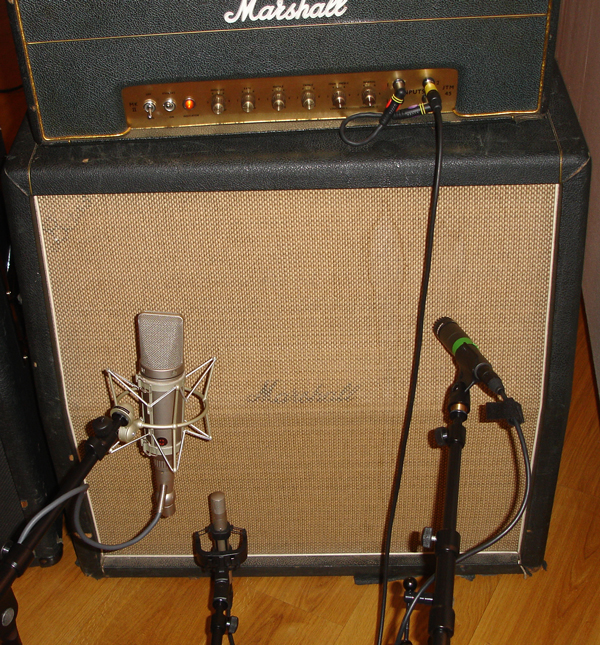
In Guy Fletcher’s last recording diary he had a photo of Mark Knopfler’s old Marshall amp with the matching cabinet. This seems to be the same amp that was used on the original recording of both Money for Nothing and Brothers in Arms.

Marshall’s first amps were basically copies of the tweed Fender Bassman. They had the same circuit and consequently the same controls, although they looked completely different. The Fender Bassman was a combo amp with four 10″ speakers, while the Marshall was just a head that was set on a cabinet with four 12″ speakers which Marshall originall intended to be used for bass.

This first model was the JTM 45. JTM is said to stand for Jim + Terry Marshall (I have sources that say Terry was Jim’s wife and another that says it was his son), while 45 stands for 45 watts. This power came from two 5881 tubes (a military version of the 6L6 used in most Fender amps) , which was later replaced with the KT66, and again with the EL34. Generally these first amps went through many minor changes, it seems Marshall bought parts in small supplies, and when the next time a component was not available at the same value, they simply took a similar one. The first amps had a rectangle metall or plastic plate with the Marshall logo, as Knopfler’s amp has the later white plastic Marshall script, it seems to be from not before 1965.

The controls were (from left to right): presence, bass middle, treble, volume bright channel, volume normal channel.

The cabinet might be from the same period.  On stage Knopfler often used Electro Voice 12L speakers in his 4×12″ cabinets, and Guy Fletcher added in his forum that he believes that there are also EVs in this cabinet (he seems not to be 100% sure). On the other hand, it might be possible that Knopfler left the original Celestion 20w speakers in this vintage cabinet, at least this is what I would have done. The EV12L has more treble than the Celestions, however, the Celestion are softer but have a distinctive presence peak. And the EVs weigh a lot more, a roady’s nightmare.

The combination of Marshall amps and 4×12″ cabinets with Celestions is what made the British rock sound famous, a warm and soft distortion with natural compression from the amp.

Note the little patch cable that connects the second input of the right channel with the input of the left channel. This trick allows you to use both channels at the same time which results in a fatter sound.

Featured artist – Richard Thompson

Let’s feature another artist today: besides Mark Knopfler, I admire the work of Richard Thompson. Richard played with England’s folk-rock band Faiport Convention in the late 60ies, and started a solo career afterwards. His first records were with his then-wife Linda Thompson who is a great singer.

Thompson has a lot of similiarities with Mark Knopfler: he is a great song writer, he is British, he has strong roots in folk music, he is a Strat hero (playing his vintage ’57 Fender Stratocaster for decades now), he often uses pick-ups 1 + 2 and often plays clean sounds over a Fender Twin Reverb, he is truely different from the mass of other players, …

Some differences: he plays with a pick plus his right-hand middle and ring fingers (like Albert Lee), he sometimes played rather weird stuff, he sells less records, …

If you don’t know him, check him out, there is a lot of stuff on youtube. I personally favour what he did in the middle-to-late 70ies or early 80ies. I put together a survey of his work over the decades, enjoy.

The first clip is for us Dire Straits + clean Strat lovers, don’t miss the guitar solos, and turn it up 🙂 Unfortunately no video, just slide show 🙁 :
– – Video not available on youtube anymore – –

Here is something melodic with Linda Thompson, folk style, a beautiful song:

… and here some more weird stuff – don’t miss the last solo (from 3:38 on) and watch how he uses the tuners for that low e string note. Note that he plays totally different from everyone who uses standard scales. By the way, the drummer is Dave Mattacks, one of my favourites. Mark played with him on a session for Joan Armatrading, on a song called ‘The shouting stage’:

– – Video not available on youtube anymore – –

Here is Richard playing solo acoustic guitar:

and another old one from Rockpalast, lots of guitar from 3:45 on:

and a more recent one:

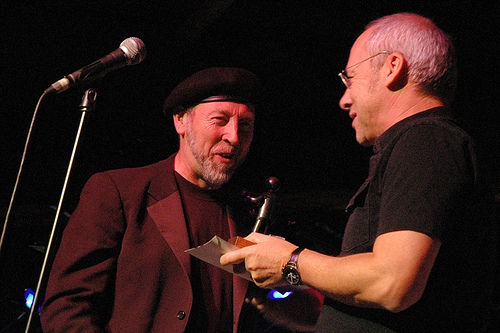
BBC Radio 2 Folk Awards 2006, Richard Thompson got an award from …

(picture courtesy Bryan Ledgard)

Dream Guitar album on Strat-talk.com – real or fake?

Today I surfed into the Strat-Talk.com forum where I found a photo album with 12 famous dream guitars. Among these were some Strats and Teles of David Gilmour, George Harrison, Jimi Hendrix, and three guitars of Mark Knopfler (the red Schecter Strat and Tele, and the red Fender), all in the same high resolution.

The question: Are these real or are they fakes? You can use the comment function to express your opinion.