The history of the Music Man company began about 1971 when Tom Walker, Forrest White and Leo Fender started a company called Tri-Sonic. Walker and White had worked for Fender before. Leo Fender himself had to sign a 10 years non-compete contract when he sold his company Fender Musical Instruments to the CBS Corporation in 1965, so he remained in the background until 1975.
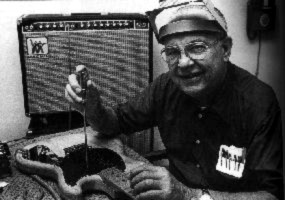
In 1974 the company name was changed to Music Man, and in 1975 Leo Fender was named as its president.
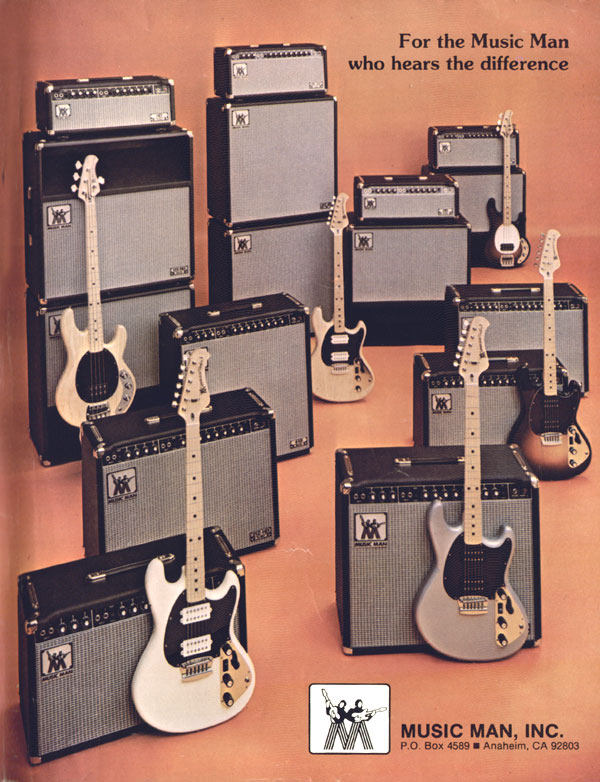
Music Man started their amp line in 1974. It is not absolutely clear in how far Leo Fender was involved with the design of these amps, most sources say that alone Tom Walker was responsible for the amps, while Leo Fender designed the guitars and bass guitars.
The first Music Man amp – a head called Sixty-five – had already most features of all later models. In very short, these are:
- A hybrid design with a tube output section and a solid-state pre-amp section
- Overall look and control layout similar to Fender amps
The hybrid design – Get that Fender sound with a solid-state design
Fender amps were basically built for a clean sound. The distortion that is created when a tube amp is overdriven was something invented by creative musicians or by chance when musicians tried to get as much volume out of their amps as possible. Fender didn`t focus on the distorted sound, in the contrary, they even tried to avoid it. In the mid-seventies , the famous Fender Twin Reverb even made use of some tricks often found in HIFI amps to reduce as much distortion as possible (the so-called ultra-linear circuit).
It is surely fair to say that Music Man followed the footsteps of earlier Fender amps, so their amps were also aimed at the best possible clean sound. So it is not a big surprise that they used a solid-state design (ICs and transistors) for the pre-amp section. Solid -state requires lower voltage and less energy and thus causes less heat. For this reason it was considered as more reliable than tubes.
The whole pre-amp section is mounted on a printed circuit board, while Fender amps still used point-to-point wiring for their amps at this time.
Tube power for warmth
The output section of the first Music Man amps used 6CA7 power tubes. A tube output section adds a certain warmth and subtle distortion to the clean sound. This is the opposite approach to the more modern approach of using a tube pre-amp with a heavy-duty solid-state power amp, a setup more suited for that singing, high-gain distortion.
The 6CA7 tube is pin-compatible with the EL34, the tube that was made famous by Marshall amps, while Fender amps mostly used 6L6 tubes (or 6V6 for smaller amps). The 6CA7 can simply be replaced with EL34. As today hardly any tube manufacturer still produces the 6CA7, most Music Man amps meanwhile run on EL34s.
However, the circuit was rather different from Marshall. The power tubes in a Music Man amp operate at up to 700 volts at the plate. Fender or other tube amps – including Marshalls – normally have about 450 – 550 volts here.
About 1980 Music Man changed from 6CA7 to 6L6 tubes. Apparently this had not to do with tonal preference but with supply facilities at that time. Generally the amps kept their typical Music Man sound, no matter whether they had 6CA7/EL34 or 6L6.
The rectifier was solid-state (diodes) and not a tube rectifier like in many early Fender amps. A tube rectifier causes a drop in voltage during the moment the amp is driven to maximum output. Thus, the sound becomes softer, similar to a compressor. Solid-state rectifiers sounds punchier and slightly harder.
Originally there was one pre-amp tube – a 12AX7 – used for the phase inverter stage of the amp. This is the stage between pre-amp and power amp. This way a certain amount of tube distortion was added. In about 1977 this tube was replaced with a solid-state version. The reason was that a certain malfunction of this tube could cause severe damage to the complete output section, including a damage to the power tubes and the expensive output transformer. The amps with the new solid-state phase inverter still sound very similar to the earlier models, but are nevertheless by some considered as sounding not as warm as before.
All Music Man amps can be switched to low power. This is not realized by switching off some of the power tubes like some other manuyfacturers do, but with a reduction of the voltages at which the power tubes run.
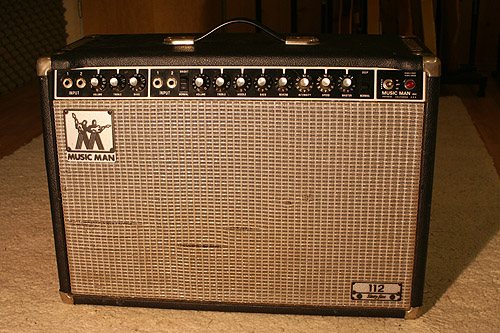
Music Man amps look very much like a typical Fender combo amp from the 60ies or 70ies. Like those black-face Fenders, they have a black control plate, a silver grill cloth to protect the speakers, and are covered with black tolex. The handle and the casters on some models are also very similar to Fender. Unlike Fenders, the Music Man amps never had those tilt-back legs that allow to tilt back the amp to adjust the speaker on the player`s ears instead on his knees.
Other features
All early Music Man amp models were 2-channel amps. The reverb and the tremolo effect affects the second channel only.
The reverb was based on a Acutronics reverb spring, similar to the one in Fender amps. However, the reverb sound is different – thinner and brighter – than the extremely warm Fender reverb. This is rather due to the circuit design than to the spring itself. The tremolo effect is very effective, but also sounds different than on Fender amps.
The Music Man logos came in two versions: the original one was black on silver, while after 1980 it was silver on black. This way you can tell the older amps from later ones at first glance.
Most early Music Man amps had speaker made by Eminence, typically models with square alnico magnets. About 1980 they changed to round ceramic magnets, still produced by Eminence. However, some models with 10″ speakers always had ceramic magnets.
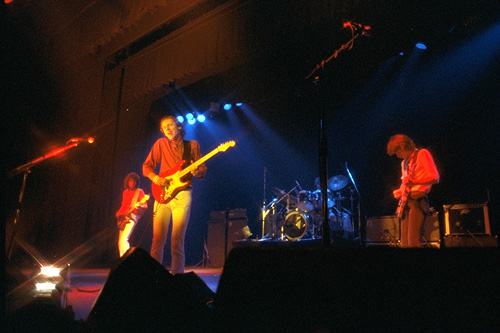
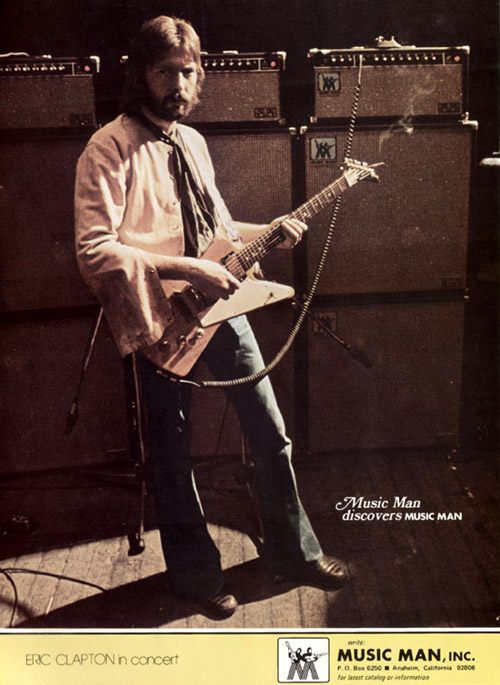
Other important players of that time who used Music Man were Eric Clapton, Johnny Winter or Albert Lee.
More information on Music Man amps can be found here. One of the next articles will cover the Mark Knopfler model, the 212 HD 130.
Related articles

48 thoughts on “Music Man Guitar Amps”
“The distortion that is created when a tube amp is overdriven was something invented by creative musicians or by chance when musicians tried to get as much volume out of their amps as possible”
Yes, totally agree. I think most of “vintage sounds” we all like so much weren’t always intentionals, it was most of the time because the guitarists wanted more volume ! Warm and drive tones from the 60’s and 70’s were maybe not what they want to have ! Perhaps, they were dreaming of clean 80’s tones in their heads ! (Hendrix always said that he couldn’t really recreate what he heard in his head) So the paradox is that now, it’s the graal of any guitarist to recreate this tones that maybe the originlas players didn’t like so much at that time ?
As I’ve explained before, the site Gilmourish explain that most of Gilmour tones from early 70s ( e.g the rhythm of Money, or the bluesy lead on Atom heart mother – funky dung) are obtained with a fuzz face at a lower volume on the guitar. I think it strange, because he could have this tones just by the amp gain, this warm vintage tone that we’re all looking for nowadays.
I don’t have tube amp, just a transistor one, so to have a warmer tone, more sustain, I have to use the drive channel, with less guitar volume, and then it`s like I had a tube amp (well not really, but you know what I mean).
But I do that because I don’t have the budget (and the room) to play on a JTM or bassman, but why did Gilmour did this way ?
Sorry, I know this blog is about Knopfler, but the multitude of different drive tones with different gain density has always interested me : when I head drive sound in any record, the first question comming to me is “how is he create this sound : “natural” saturation of the amp, or “artifical” distortion of an effect ?
If I had heard the Ingo demo about recording with 2 mics without his information, I would have guess that he was using a fuzz, bluesbreaker, crake or so one, and he wasn’t. And when I listen to Floyd, I was quite sur that it was just amp, and it wasn’t.
So very difficult to say (to me at least)
Other example : Revolution by the Beatles (maybe one of the more saturated tone I’ve heard) is made (to my mind but not sure) by cracking the amp, and maybe the sound take (compressor, desk, I don’t know)
Well, it’s the same about Knopfler in the 80’s : drive tones of 83-85 were made just by Mesa-Boogie, or any effects ? (I think of TR, Tunnel, Solid Rock, Ride across, One world….)
Another great band that used MusicMan amps is Heart. Both Nancy Wilson and Roger Fisher used MusicMan amps in the studio for BARRACUDA. I’ve also seen pics of them on stage using MusicMan amps as well.
I recently came across your blog and have been reading along. I thought I would leave my first comment. I don’t know what to say except that I have enjoyed reading. Nice blog. I will keep visiting this blog very often.
Margaret
http://guitarlearntoplay.net
I am trying to find a circuit dia. for Music Man Amp 2275-130. Ser. No. B003190. thank you
see here: http://www.pacair.com/mmamps/schematics/index.html
Musicman AMPs were really great AMPs!
I tried to built the 212HD – 130, but the Problem was, that there are some transitors which you can´t buy nowadays.
But you can buy cheap amps on ebay, but there is the next problem, if ah transitor break down, it is impossible to get new ones.
So now I´m working on ah self build brown Fender Vibrolux.
I repair, restore and mod The old Musicman amps. I mod them in way that can be returned to stock at anytime. They are great sleepers. I have been able to get very good sounds from these amps with my mods. Check out the HD-130 mod clip on myspace. My customers have said they have not been able to replace their Musicman with the Boutique amps today. The Musicman is capable of an honest tone and can be made to sound like the best Fender with a great clean boost like a Klon in front of a Deluxe or Twin. Good speakers are important as well, depending on the tone your going for.
email me for info at goforthsound@yahoo.com or check out the clip at http://www.myspace.com/goforthound HD-130 mod.
Do you have any mods for a Music Man RD-110? In particular, an effects loop
ops! I must be missing a finger, I mis spelled the URL, sorry 🙂
Ed
try http://www.myspace.com/ goforthsound
I purchased a Music Man 210 in 1973 I need to replace the the cones or the speakers.
My email is: happydaze128@yahoo.com I LOVE THIS AMP. I’ve found nothing that compares.
Who can I contact to talk about my speakers.
Thanks,
Roger Tune
I have had a gs412 cab for about 20 years. I finally found the right head it is a HD150.This head and cab sound amazing together.If you turn it up and stand to close it will literally blow the hair on your legs.Nothin but tone.All I use is a delay and a Korg Mr.Multi phase/wah. What a blast!!!!!! Thanks again to Leo
Great Blog, I recently acquired a 65 115 in extremely original condition (original eminence alnico 15 dated Oct 1977) I love the sound, best spring reverb I ever heard. I run through a rack rig with a channel switching Dean Markley DR preamp, so the channel switching issue is not a problem.
Love the Music man guitars amps and of coarse the basses! Keep up the good work
Justin
Russellville AR
I purchased a 212 130 Music Man amp in 1973 at the age of 14. It has serial number 76 on it and I was told that they were numbered sequentially.. After college I sold it to my best friend who kept it for 6 years when I contacted him and offered to buy it back. Thank god I did. Thirtyeight years later I am still proud to say that this amp is the star of my 4 amps. I have played many different amps and always come back to this one.
Hi Ken, I also own a HD 212 (One fifty), where can I fiend the serial number on the amp?
How much is a 77′-78′ Music Man 410 Sixty Five worth?
I bought a Musicman amp in 1989 for £300
It’s very heavey so I don’t take on gigs as I am 66 but it has a beautiful sound.
I would be interested to know how much it is worth.
One of these links should work:
http://a5.sphotos.ak.fbcdn.net/hphotos-ak-ash4/228697_10150230763847533_630402532_8555219_7499893_n.jpg
http://www.facebook.com/media/set/?set=a.10150230763652533.360942.630402532#!/photo.php?fbid=10150230763847533&set=a.10150230763652533.360942.630402532&type=1&theater
The first one works!!
I have an HD-130 head, black on silver (and 4×12 cabinet), original owner. Can anyone comment about settings when running a recent Tube Screamer into the main channel? Sounds great with the TS-9 that I have. I’m considering giving the pedal the “Keeley Mod” so the output of the pedal is more electrically (and acoustically) similar to a TS-808. A lot of guys use the current TS-9s with this mod which pairs well with a tube pre-amp. But I’ve got an HD-130 with the solid state pre-amp and 12AX7 tube phase inverter. The guy who works on my gear replaced the power tubes with Groove Tube EL84s, they sound great. Wondering if anyone has experience with the Keely mod TS-9 running into the solid state pre-amp (before I simply just go ahead with the changes to hear how it sounds). Presuming these days, that most good OD pedals will sound just like an overdriven tube pre-amp when this HD-130 is set to clean.
I have done these mods and came up with my own for the Tube Screamer and Marshall Blues Breakers, Zendrive, OCD, COD, Big Muff and others. The preamp on these amps can be setup to work like a pedal into a great tube amp with my mods, just tell me what you want and I will work out the details, need an effects loop, the right way? How about channel switching? Or just some tone enhancements. I just finished a Mesa Boogie Bottle Rocket, the mods are inspirations of the Dumble HRM Lead channel, now it sounds much like the amp Robben Ford plays through on “Hand full of Blues” etc. It’s just a preamp pedal with 2 12ax7’s I tend to go for smoother, more articulate tones, some of the Dumbles are a bit mid heavy and can sound harsh or muffled to me. Email me if you want to hear a sound clip at goforthsound@yahoo.com
NO spammers Please!
I’ve got that same 130 4 12 GS setup and I have a modified Keeley Tube Screamer……Mecca has been achieved. I’m a huge MM amp fan. I’ve played through everything and this is it. I use either and HD 130 with the 4 12 GS cab or my HD 130 4 10 combo. Both of them rule. Usually run them at low power but turned up.
Check out my Music Man mods here. I was on My space, but it was getting too much crap from Rappers wanting to use my Blog to advertise their CRAP, oops, RAP that is!
http://soundcloud.com/goforthsound/david-gilmour-solo-sorrow
Modded HD-65 Bass head modded for guitar with 12ax7 driver.
http://soundcloud.com/goforthsound/hd-130-in-low-power-mode-mp3
Modded HD-130 Bass Head for guitar with Preamp send/return jacks, channel switching
and voiced for guitar with a bit more gain. This is in the Lead channel.
http://soundcloud.com/goforthsound/rd-50-with-weber-hemp-alnico
RD-50 with Weber hemp/Alnico 10″ and my Fender Deluxe 1 mods.
http://soundcloud.com/goforthsound/rd-50-reverb-upgrade
RD-50 with upgraded reverb.
http://soundcloud.com/goforthsound/chris-cain-through-my-modded
Chris Cain playing through one of my modded amps owned by Richard Lunetta, Corona CA.
http://soundcloud.com/goforthsound/rd-50-with-jbl-k-120
RD-50 Tweaked to 64 Fender Blackface Deluxe specs.
http://soundcloud.com/goforthsound/64-deluxe-jbl-k-120
My 64′ Fender Blackface.
http://soundcloud.com/goforthsound/hey-joe-zz-top-rd-50-mod
Me Jamming with ZZ Top with a RF1 Modded RD-50 for smooth Robben Ford-like tones.
(NO, that is not a new type of Dildo, it’s the actual waveform of the track, as some have asked….. :^/
Hi I have a Musicman 212x 65 watt since 1981, bought new. How much is this amp worth. Excellent condition.
Thanks. Joseph.
Would love a small, one speaker good quality combo with warm tone.
Difficult to tell, prices vary. In the US they are cheaper than in Europe where it should be about 400 – 600 Euros I’d say.
Dear Sir,
Have a nice day.
This is Fenny from Rowin Music,which has specialized in guitar accessories for 5 years,our main products are tuner,digital metronome,pedal tuner ,capo tuner and effect pedal,the products we supply are top quality and competitive price.
For more details,just contact me directly,I would endeavor to give you every satisfaction.
Awaiting for your response. Thanks for your time.
Best regards,
Fenny
i am tryiong to find out what year my musicman amp is serial number is 000188 thanks bill
After 35 years, I am still using a Music Man RD-100 switching head into two JBL E-110’s (4 ohm load). Many people mistake the moniker as meaning “100 watts”. There is no way to derive any more than 50 watts from two 6L6 power tubes, unless it’s pink noise into a 2 ohm load – for about 5 seconds before everything melts. I consistently get compliments on my sound. The amp has been in the shop twice in 35 years; once to replace the on-off switch, and again to replace a tube socket which cracked after a monsoon rain hit the stage I was performing on. The cold water hitting the hot tube socket caused the failure. The amp once survived a 6 foot drop on to solid concrete with no damage whatsoever.
ich bin in Deutschland – Bayern – beheimatet und bekomme nächsten samstag einen mm rd 50 112 in einem gut erhaltenem
zustand. der amp hat noch die alte 12ax7 preampröhre. nach einigen wochen erhaltet ihr einen erfahrungsbericht.
es grüßst euch Charlie und spielt euch die finger nicht wund.
Hi please explain HI and Low Switch on the Musicman 212HD. Thanks.
It switches from high power to low power. It does not switch off two tubes like other designs but decreases voltages for lower output. In most cases the low setting will do, and it saves tube life. Mark seemed to have it always in the high position.
I have a 212 HD one thirty…..someone took the fuse cap and fuse from my amp. Where can i get a replacement
It works the same as a Level and Volume or Level and Gain knob on other amps. It’s just how you get ovredrive from an amp with no ovredrive channel. Actually I think the Master should be cranked and the Volume down low. But different amps have different settings. Either way, one adjusts the amount of volume and the other adjusts the amount of gain (or distortion). Just play with it and find the settings that YOU like best.
Hi i have had a m/man 210 hd one thirty fo 30 yrs. ,great sound , thanks from bryan .
Hello, I am the proud owner of an old Music Man 212 HD One fifty. I am looking for the wheels to mount under the amplifier.
Does anyone has the specs of these wheels?
Much appriciated!!
Hi General inquiry. I have a 1974 music man 210 HD 130 in absolute pristine condition . Can anyone tell me what it would be worth as I’m looking to sell it on. 1 owner from new
Regards Matt
Is there a mod to tap into the preamp to run effects loop, RD65-210, 2275 chassis?
Bought this amp in early 76 when 16 and have only replaced the knobs and the grill cloth (same types as fender, funny that), serial number BN03001
Nice article but keep in mind that Fender NEVER made any amps that used point to point construction. Tag board, eyelet board, turret board etc layouts are not point to point construction which is also know as a rats nest.
1) The “tag board” was a Fender invention, used in the building of their point to point, hand wired amps and is still used in certain models today.
From the Fender website…
“For a taste of both methods, Fender continues to offer point-to-point amps—like the ’57 Custom Twin and the ’57 Custom Pro—and PCB amps, such as the ’68 Custom Twin Reverb and the Hot Rod Deluxe.”
2) 1960’s and 1970’s Traynor tube amps used eyelet boards for all of their chassis, all of which were point to point, hand wired.
3) I personally know a rather well known current boutique, point to point, hand wired tube amp builder who uses a turret board for his point to point, hand wired tube amps. We were discussing his turret board assembly just a couple of weeks ago, as a matter of fact.
A “rat’s nest” refers to a poorly laid out design, not a point to point amplifier. The term isn’t even specific to amplifiers, it is an electronic tech/electrician’s term used in general, to describe any messy or cramped wiring arrangement.
What kind of wood are the cabinets made from, type of joints etc.