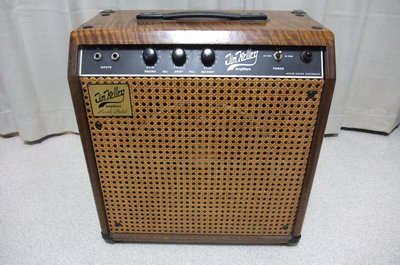
Jim Kelley was a small manufacturer of boutique amps who started his business in the late 70ies. He started with only one amp model, a single channel amp with 6 tubes and just 3 knobs. The later dual channel was still based on this model.
Compared to other boutique amp that were favourits at that time – namely Mesa Boogie or Dumble – the Kelley amps followed a different approach. While the Mesa Boogies had lots of controls and options (various push/pull knobs, EQs, different gain stages etc.), the Kelley had just 3 knobs and followed the idea of having a simple signal path without any redundant components to obtain a pure and natural sound.
While the Mesa Boogie made use of two different pre-amp sections that were chained in serial so that the first can overdrive the second to get high-gain distortion even at low volume, the Kelley favoured the more natural sounding distortion from the power amp. As this automatically results in high volume, the amps were often paired with a power attenuator ( a device between amp and speakers that turns a part of the output power into heat to reduce volume).
The Kelley amps soon get very popular among session players on the US West Coast, they became the “house amplifiers” of the Shangri La studios (the place where Mark Knopfler recorded his Shangri La album decades later), and were soon exported to Japan and Gemany (by the way, the German distributor was the music shop in my hometown where I played a Kelley amp for the first time in the early 80ies). On the US East Coast they were sold at Rudy’s Music Stop in New York, where John Suhr and Jack Sonni worked at that time, who introduced this amp to Mark Knopfler. According to Jack Sonni, Mark played his Kelley amp and his foam green Schecter Strat for the recording of One World (from the Brothers in Arms album) and loved the sound so much that he used the Kelley amp on the Brothers in Arms tour (1985/86).
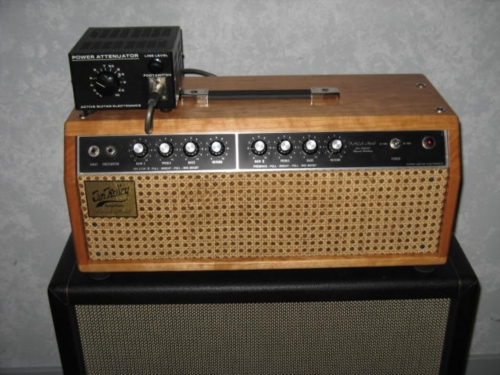
The model Jack Sonni and Mark Knopfler used was the dual channel amp, the FACS (for foot activated channel switching). These amps were available as combo or head (Knopfler and Sonni used the heads) and had two identical pre amps so that each can be adjusted for a different sound, with a reverb control for each channel. As the idea of the Kelley’s distortion sound was to overdrive the output stage, different gain settings would automatically lead to different volume. Here the attenuator comes in, which was activated when switching to the overdriven channel so that you can match the volume to your needs.
Technical stuff
Each channel has a gain, treble, bass, and reverb control (from left to right). The treble control can be pulled to act as a bright switch, while pulling the bass control adds a mid boost. Pulling the gain control on channel one – which was intended as a the overdrive channel and is paired with tghe power attenuator – allows you to switch the channels without the foot switch, pulling out the gain control of the second channel enables a presence boost.
The output stage uses four 6V6 tubes and can be switched to 30 or 60 watts, while 12AX7 tubes were used in the pre , as phase inverter, and to drive the reverb. The Brothers in Arms tour was one of the longest tours a major rock band ever did, and thus surely meant a particular stress for the gear. This lead to some tube failures so that Jack Sonni finally changed to a Seymour Duncan convertable amp towards the end of the tour which seems more reliable.
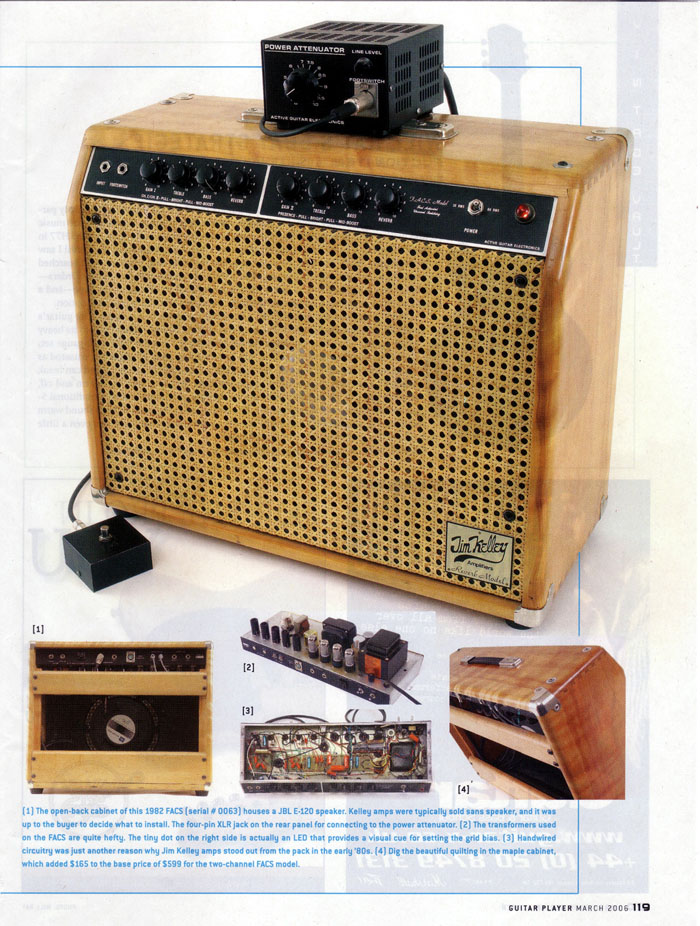
Unfortunately there aren’t any pictures that show Mark’s amps as these were placed behind the stage where they could be operated by a technician. You can see one of these – probably Jack Sonni’s – on the video of the Live Aid concert in July 1985. The pictures do not show Knopfler’s amp but similar ones.
11 thoughts on “Jim Kelley amps – the FACS model used on the Brothers in Arms tour”
Hi all,
Suhr Guitars is now selling a Jim Kelley Single Channel 60W combo or head, Limited Edition.
http://www.suhrguitars.com/JimKelley.aspx
The info on the web page is nice and it is including some good videos of different settings and also about the attenuator.
It is interesting to notice that the speaker fitted is an ElectroVoice EVM12L.
Enjoy!!!
Eduard.
Right, I also just found out, a bit after publishing the article but you were faster than me 🙂
This makes the whole experience stress free and enjoyable.
Whether you are in Agra for work, a short trip, or a holiday, having a pleasant companion can make your stay more comfortable.
This is a fantastic deep dive into the Jim Kelley amps and their unexpected role in the iconic *Brothers in Arms* tour! It’s fascinating how a boutique amp with a minimalist design, prioritizing natural power amp distortion, found its way into such a major production. The details about its use on “One World” and the reasons behind its distinctive sound really shed light on Knopfler’s tone during that era. Knowing how these technical choices shaped such legendary music is truly insightful. For anyone curious about visualizing this kind of historical gear, an AI Image Generator By Nano Banana Pro could even help create some cool conceptual images based on these descriptions!
This is a truly fascinating deep dive into the Jim Kelley amps and their unexpected but significant role in the iconic *Brothers in Arms* sound. It’s amazing how Mark Knopfler gravitated towards the simple, pure signal path of the Kelley, opting for natural power amp distortion over the more complex options of other boutique amps at the time. The insight into the FACS model and especially the dual-channel design with the integrated attenuator for volume matching really highlights the thoughtful engineering behind these “house amplifiers.” It’s these kinds of detailed historical accounts that make music tech so compelling. For anyone wanting to dig deeper into the actual interviews or documentaries that might mention these amps, a tool like YouTube Transcript Generator would be incredibly useful for quickly finding those specific mentions. Thanks for sharing such a well-researched piece!
This is a fantastic deep dive into the Jim Kelley FACS amp used on the Brothers in Arms tour! It’s always fascinating to learn about the specific gear that shaped such iconic sounds, and the contrast between Kelley’s simple, pure signal path and the more complex Mesa Boogies is particularly insightful. The detail about the power attenuator being crucial for achieving that natural power amp distortion at manageable volumes really highlights the thoughtfulness behind its design. It makes me wonder if there are any pixel art renditions of these classic amps out there, which reminds me, if you’re looking to turn your own gear photos or ideas into cool retro art, you should check out the AI Pixel Generator!
This is a fascinating deep dive into the Jim Kelley FACS amp used by Mark Knopfler on the Brothers in Arms tour! I especially enjoyed learning about the “simple signal path” philosophy behind Kelley’s designs and how that contrasted with other boutique amps of the era. It’s cool to know the story behind Knopfler’s tone on “One World” and the role an attenuator played. It just goes to show how much detail and intention goes into a musician’s gear choices. Speaking of making a strong impression, for anyone looking to optimize their visual presence, you might find Attractiveness Test a helpful tool for picking profile photos!
This is a fascinating deep dive into the Jim Kelley FACS amp used during the *Brothers in Arms* tour! Learning about the philosophy behind Kelley’s simple signal path, favoring natural power amp distortion over complex pre-amp chaining, really highlights a different school of thought compared to the Mesa Boogies of the era. It’s especially cool to know the story of how Jack Sonni and John Suhr introduced Mark Knopfler to these unique amps. For anyone needing to share their own in-depth guitar gear analyses, converting detailed notes from Markdown to a polished document is a breeze with Markdown to Doc. Thanks for shedding light on such a pivotal piece of Knopfler’s tone!
This is a fascinating deep dive into the Jim Kelley FACS amps and their role in the iconic *Brothers in Arms* tour! The detail about the “simple signal path” versus the more complex Mesa Boogies really highlights Kelley’s unique philosophy – aiming for that pure, natural power amp distortion. It’s incredible to think that a decision based on tone could lead to such high volumes, necessitating attenuators. The tidbit about John Suhr and Jack Sonni introducing the amp to Mark Knopfler is a great historical link. It’s a shame there aren’t more clear photos of Mark’s specific setup, but the Live Aid reference is a good workaround given the constraints. For anyone working with guitar rig photos, or any images really, managing them effectively is key. I recently discovered Merge JPG, which is incredibly useful for combining and organizing image files directly in your browser – no uploads needed, which is a huge plus for privacy!
This is a fantastic deep dive into the Jim Kelley FACS amp used by Mark Knopfler on the Brothers in Arms tour! I love how you highlight the “less is more” philosophy behind Kelley’s design, favoring natural power amp distortion over complex pre-amp chaining. It’s fascinating to learn about its popularity among session players and the serendipitous way it found its way to Knopfler through Jack Sonni. The technical details about the attenuator and channel switching also provide great insight into how these amps achieved their distinctive sound. For anyone interested in visual documentation of gear, you might find Image to Prompt useful for generating descriptive text from historical photos of Mark Knopfler’s setup, even photos where the amps are less visible!