Installing a Highlander iP-1X – The best pick-up for the National resonator guitar

I have my National for some years now but never found the time, money, and courage to install a pick-up into this sensitive instrument. But a few weeks ago I decided to order what is said to be the best available pick-up for single cone Nationals: the iP-1X pick-up from Highlander – the same model that Mark Knopfler has in both his beautiful 1937 National and his new National.
I bought it new on ebay for USD 239 (169,- €), quite a lot of money for just a pick-up with an internal pre-amplifier, well, but a lot cheaper than the recommended retail price of USD 329.

What is always annoying here in Germany is that you have to pay not only customs (which in this case were only 2.7 %) but also 19% VAT, and this not only on the price of the item but also on the shipping costs (!?). You even have to pick-up the package from the local customs office.

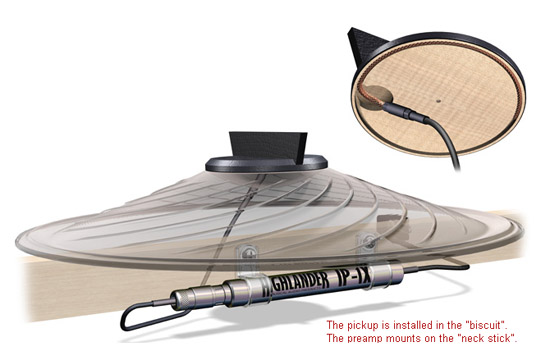
In the box were the pick-up itself which is installed into a new biscuit (the piece of wood that holds the bridge) – so you have to exchange your old biscuit – the pre-amp which has to be installed in the interior of the guitar, a case for the external battery (replacing batteries inside of a National is no fun and puts stress on the cone construction), a guitar cable (stereo, one lead for the 9v battery power), and some velco tape to fix the cables inside the body of the guitar.

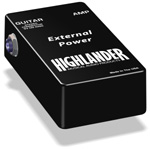
Highlander iP-1X

Installing the pick-up

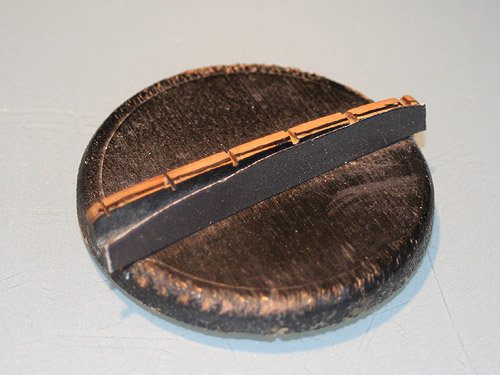
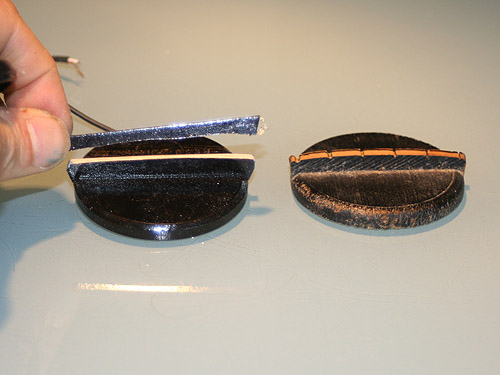
Unfortunately this is a job that is not easily done, and does not take just a few minutes. The new biscuit with its bridge is much higher than the original one and has no grooves. It took me almost three hours to transfer the shape and height of the original bridge to a cardboard template, then to transfer it from the template to the new bridge, to cut it out roughly with a fret saw, to fine tune the contours with a file, and to saw the new grooves, again using the template. Of course I did this extremely carefully and slowly because I was afraid to cause some irreversible damage. Fortunateley the new bridge soon looked fine and was ready to install.

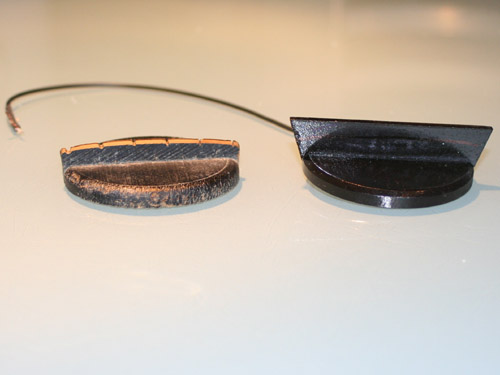
This picture shows the difference in height and shape of the bridges
This picture shows the difference in height and shape of the bridges. The old biscuit looks much cooler, doesn't it - but you don't see much of it when installed into the guitar.
I used such a cardboard template to transfer the bridge contour
The new biscuit after sawing
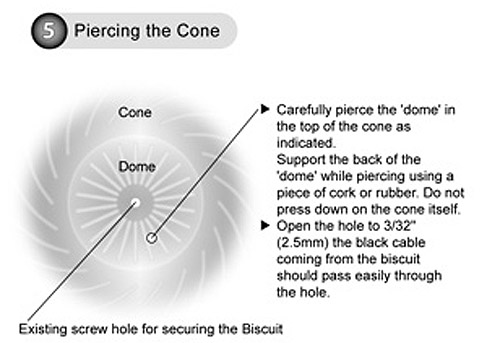
From the installation description - you need to pierce a hole into the cone

Normally you would ask a good local luthier for this job, but (a) there was noone near who had experience with Nationals and this pick-up, and (b) I like to do all kind of jobs on my guitar myself anyway. An experienced repair man surely will get this job done much quicker than me.

The external case for the battery

One thing that worried me was the fact that you need to drill a small hole into the cone (!) for the cable from the pick-up to the pre-amp. Besides two tiny screw holes on the wood stick inside the body to hold the pre-amp, this is the only irreversible modification of your guitar. I was reluctant when I learned about this before I ordered the pick-up because the cone is extremely sensitive, and also in my opinion a major sound difference between a vintage instrument and a new National. The hole could be pierced with a small prick first, then carefully drilled to 2,5 mm (3/32 “).  After threading the pick-up cable through the hole, I had to solder the RCA connector to the cable that is plugged into the pre-amp.

The rest was easy: the pre-amp is held by 2 little screws, like Mark Knopfler I used the f-hole for the output jack (no drilling required), and fixed all internal cables with the velcro tape.

The sound

After restringing the instrument, I was extremely curious how it will sound. I went directly from the pre-amp into the mixing desk and played the guitar over my studio monitors. What should I say, the sound was …. wonderful, sounds as you hear it from Knopfler’s guitar on his live recordings. The output seems to be rather hot, and the pick-up delivers the full range from bass, middle, to treble end. It is so balanced that I even did not have to adjust any EQ, sounded fine as it was. After adding some reverb it was perfect. I also could not detect any sound difference with the acoustic sound. Even at high volume I did not get any feedback problems, great!

Now it was also time to add a strap button to the heel of the neck so that I could play the guitar when standing, something I did not need before. I did not produce any sound clips because it really sounds just like the recent Knopfler live recordings (he had different pick-ups installed in the past I think), listen to Romeo & Juliet on the roadrunning live CD for example.

I would give 5 stars for this product.

Cover version of Dire Straits Six Blade Knife

During the last weeks I played around a bit with the backing tracks from the Jam with Dire Straits book by Total Accuracy. Some of these are great and sound very good. Unfortunately, the  one for Sultans of Swing seems  almost unusuable to me because of the harsh rhythm guitar sound. Since I still had a Cubase file with the MIDI drum part of Sultans – something I did with a cover band I played with in the mid 90ies – I decided to revive it. It was  programmed for the Alesis SR 16 drum computer we had in those days, but now I used it with Battery, a VST instrument by Native Instruments.

The backing tracks

Battery allows you to load many different drum kits, and to replace drum sounds with your own samples. As I love the sound of the first Dire Straits album, I sampled the snare and a bass drum from this CD for that authentic drum sound. Since this was a lot of fun, I also made a backing track for Six Blade Knife. The drum part is very simple so this was not too much work. What I did to make it sound less sterile was to analyze the micro groove pattern of Six Blade Knife and tranfer it to the MIDI drum part (the Cubase experts will know what I am talking about).

Next I added the bass track and a rhythm guitar. The bass was an old Precision bass, while I used my blonde  ’70 Telecaster for rhythm. I admit I was lazy, so I played the guitar directly into the desk.

Both tracks are nice to jam with, especially since our little homerecording studio has a small PA now, no need for headphones all the time anymore. We even have a few LED lights now. The days of the old -fashioned halogen spots seems to be almost over. The new LED spots need only a fraction of the electric power, and you can mix every colour with the RGB LEDs of one single spot. I programmed some lighting scenes and triggered these from the Cubase arrangement. I used two digi cams for filming myself  jamming with the Six Blade Knife track.

The backing track is available here.

Guitar sound

It is basically a live recording, vocals and guitar played live and recorded with Cubase, no post editing. Except a bit EQ there is no post processing on the guitar, no compression, no effects. The reverb was from the Music Man amp, and delay was my green MXR analog delay. The signal chain is pretty much what Knopfler played during the Communique tour.

I used the Shure SM 57 for guitar, and for the vocals. It is basically a mic for guitar or snare drum, but for some odd reason I always liked it better for vocals then the Shure SM 58.

I play different licks here and there whenever I play one of these songs, most licks origin from some old live recordings, others are my own versions. I don’t think it makes much sense to copy a particular version of the song, but I tried to copy the overall feel.

The video

I never have done a two-camera video before, but this was really easy. I put the sound recording on one audio tracks and imported the video files on two different video tracks. After enabling the wave form display of the sound file and of the audio tracks of both video  tracks, I only had to adjust the video files so that the sound of all of them was in sync, then I switched off the sound of the video tracks. LED lights are not ideal for filming – at least not the affordable ones – so some colours do not look as good  on video as they did here, but all in all this was not a problem.

So, here is the final video. Let me know what you think of it here, or leave a rating or a comment directly at youtube (you get there directly when you click on the video while it is playing).

Mark Knopfler on facebook and myspace

In todays post I just want to direct your attention to the official Mark Knopfler facebook and myspace pages:

Mark Knopfler on facebook

Mark Knopfler on myspace

Both have been regularly updated during the last weeks. The facebook pages now feature some preview clips of Mark Knopfler’s new album Get Lucky (release scheduled for September 14), e.g. a video ad in which you can hear snippets from the songs Get Lucky, Border reiver, and Remembrance day, and you can listen to the full track Border reiver.

Cover version of Setting me up by Albert Lee

Many Mark Knopfler fans like Eric Clapton and are familiar with his work. Especially his live album Just one Night from 1979 was a milestone in his career. It features a live version of Setting my up – a Mark Knopfler song from Dire Straits’ first CD. However, many do not realize that this cover version has not much to do with Eric Clapton. Instead this song was meant to feature Albert Lee who plays the second guitar on this tour. He had just recorded Setting me up in the studio for his solo album Hiding (1979). In a similar way Mark Knopfler played one of his songs –  Money for Nothing – when he went on tour with Clapton in the late 80ies.

The album Hiding was not available on CD until a few year ago when it was reissued. It is a well-produced album with about 20 laid-back country-rock songs,  something many Mark Knopfler fans will probably like.

ALBERT LEE
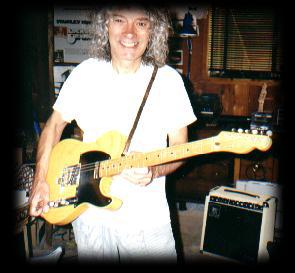
Albert Lee with his Telecaster

Albert Lee is a fantastic guitarist of course. He is one of the ultimate Telecaster players (although today he plays his Music Man signature model a lot). He perfected the pick-plus-two-fingers approach, a bit similar to Richard Thompson‘s picking technique.

Here is a short sample of this studio version of Setting me up by Albert Lee (from my vinyl):


You can buy the CD on Amazon, simply follow the link for your country (US, Germany, UK) below.

Mark Knopfler chord shape of Vic and Ray and for a lick in Money for Nothing live intro

In this article I will cover a little chord progression that Mark Knopfler apparently discovered some day and – as he sees himself mainly as a songwriter – directly translated into a song. He often learned such little patterns and licks by accident – finding something when playing for hours – or learned them from one of his mates, people like the great Chet Atkins, pedal-steel player Paul Franklin, or Richard Bennet.

Here is a little audio clip where Knopfler plays the particular riff I am going to talk about. Here he plays it in the key of G, one full note lower than in the Vic and Ray example below.


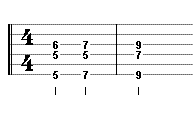
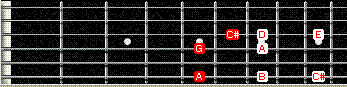
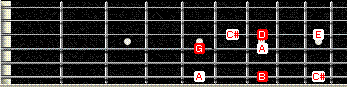
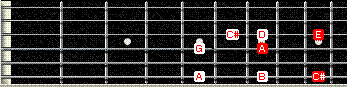
This pattern appears in the song Vic and Ray from Knopfler’s first solo album Golden Heart (1996). It starts with an A7 chord fragment, followed by a G chord with the B in the bass, and finally another A chord, with the C# in ths bass.

First as a tab:

vic and ray tab

Here as pictures, showing each of the three shapes you have to play in red:

Vic and Ray 2

VicandRay3

VicandRay4

Note that from shape one to two, one note (the g on the d-string) remains the same and can be sustained, and that the third shape is the same as the second, just two frets higher which means you simply need to slide two frets higher. Check out my video below for left hand fingering (I found there are two ways that work for me).

Adding a chromatic transition chord for Money for Nothing lick

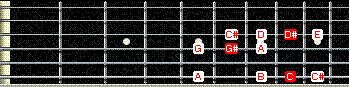
It was only recently when I realized that the funny chromatic licks that Knopfler played at the beginning of Money for nothing in Nimes on the On Every Street tour (1992) make use of the same pattern, you only have to add another shape – the chord between shape two and three in the pictured above:

vicandray5

Then move it to the key of G (two frets lower), followed by the same pattern in C, next in D, and you have those chords for Money for nothing (see my video, at 5:10 it also contains a link that takes you directly to a clip showing Knopfler playing that thing in Money for Nothing).

Dire Straits Down to the Waterline explained: licks – chords – solo – no tabs

Summer is here and with it my summer holidays, so the ideal opportunity for some more song tutorials here in my Mark Knopfler guitar blog. This time I will explain the song Down to the Waterline – the first song on the first Dire Straits CD (1978).

Down to the waterline is surely another highlight of early Dire Straits. It is one of the oldest Mark Knopfler songs, one of 5 songs included on the demo tape Dire Straits recorded in summer 1977. It is the opener of the first album and was planned (however never released) as a second single, following the band’s first single success Sultans of Swing.

It is in the key of Bm and features many guitar licks and stuff that is typical for this key but also a lot of surprises like some unusual chord changes in the middle solo or some chromatic notes.

I am explaining the whole song in a youtube video or – to be precise – in two parts since youtube allows only clips up to 10 minutes. I am showing the song as I would play it – which is a mixture of the studio or some live versions. As always, it is not about the most accurate transcription of a particular version, but about the idea behind those licks, chords and solos.

Video Part 1 (Intro, verses, chords, first solos)

Video Part 2 (middle and last solo)

Knopfler probably played his Fender Strat S.-No. 80470 on the CD version of this track, possibly over a Fender Twin and/or his brown Fender Vibrolux amp. Besides some reverb and slight distortion from the amp, the guitar sound is compressed, possibly by the Dan Armstrong Orange Squeezer. However, noone knows for sure about the gear actually used on the first two CDs, and there is a lot of rumour around.

Some notes on the gear I used for this video

self-built clone of the Mark Knopfler Fender Strat S.-No. 80470 (mainly of Fender parts) , into Morley Volume pedal, into MXR analog delay, into Music Man HD 212 amp

recorded by the mic of a digi cam.

Which key is In the Gallery on the first Dire Straits CD? Am or Bbm?

The song In the Gallery of Dire Straits’ first album seems to be in a strange key. The official songbooks transcribe it in the key of Bbm. On all live versions Dire Straits played it in Am. So, why is this?

If you listen carefully to the CD version and and try to play along with your guitar, you will notice that Bbm seems to work better than Am, but still is not perfectly in tune with the recording. The reason is that apparently In the Gallery was played and recorded in Am, but then it was for some reason decided to speed it up a bit. In other words, the pitch/speed control on the master tape machine must have been turned up a bit, probably because the recorded version was regarded as too slow. (The theoretical second explanation that they simply tuned all guitars a bit higher does not really make sense to me.)

For this reason it is also higher than standard tuning, about 3 – 4 % (Bbm is a semi-tone higher and would equal about 5 -6 % speed increase). Today there are computer algorithms (called time shifting) which allow to change the speed of a recording without altering pitch, but nothing like this was availaible in 1978 (and even today these algorithms often create audible artefacts like distortion or a weird sound).

You can easily revert this change and reduce the speed with a computer algorithm so that the song is Am again – the same speed and pitch it was recorded at. I did this for you, so here is In the Gallery as it was really played.


The difference is subtle of course but still clearly audible. The voice sounds deeper and fuller, also the guitar sound changes a bit and appears darker. It is also a question of taste which one you like better and which one you regard as more original – the one as it was really played, or the one with the intentional artistic change. You can leave a comment (even without registering or leaving an email) to let me/us know what you think about it.

Mark Knopfler’s 1938 Gibson Advanced Jumbo acoustic guitar

Mark Knopfler owns two beautiful vintage Gibson acoustic guitars which he seems to play a lot on his studio albums these days. One is a 1953 Gibson Southerner Jumbo, the other a 1938 Gibson Advanced Jumbo which I would like to feature in this article.

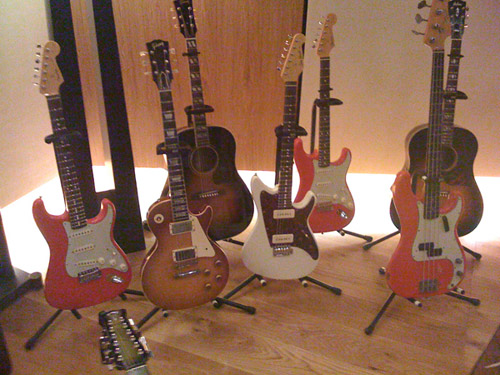
The 1953 Gibson Southerner Jumbo is the acoustic guitar in the centre, the 1938 Advanced Jumbo the one on the right side
The 1953 Gibson Southerner Jumbo is the acoustic guitar in the centre, the 1938 Advanced Jumbo is the one on the right side (picture courtesy Guy Fletcher)

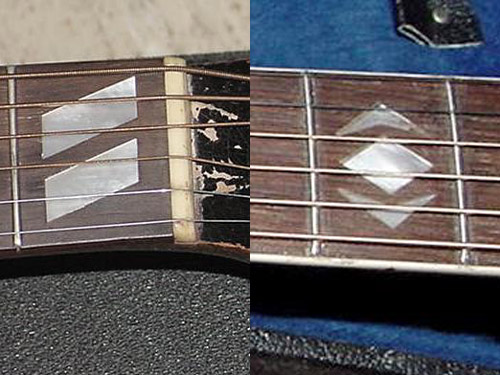
Both have a sunburst finish and thus look a bit similar at first glance. Besides the different body shape, the different fingerboard inlays tell you the model when you see Knopfler playing one of these on any pictures or videos. While the 1953 has double parallelogram pearl fingerboard inlays, the 1938 has the so-called diamond and arrowhead inlays.

Left: parallelogram inlays on the 1953 Southerner Jumbo, diamond and arrowhead inlays on the 1938 Advanced (right)

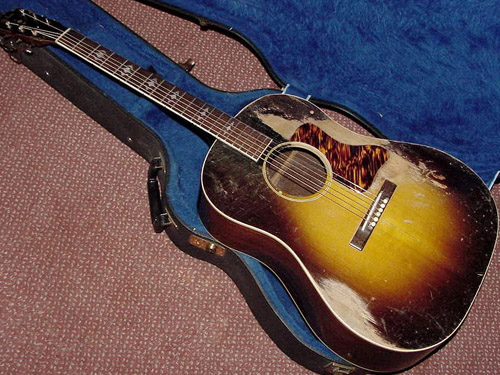
The Advanced Jumbo was only produced this way from 1935 to 1940 (but was reintroduced in 1990) , and only about 300 of these were made. It was the top of Gibson’s acoustic guitar line back then. The neck has a slimmer shape than on some other Gibson models. Maybe for this reason Knopfler prefers it for playing licks and different stuff on it, and possibly rather uses the 1953 for strumming.

The back and sides are of rosewood, while the neck is mahogany. The Advanced Jumbo was only available in sunburst, note that guitars from before 1938 had less yellow than the 1938 on the following pictures (courtesy provide.net/~cfh/).

gibson-advanced-jumbo

If you want to learn more about all special features and specs of this guitar, I recommend this great site.

I played a few old Gibsons but not an Advanced Jumbo, but all I played sounded great, sometimes even “too good to be true” (like an 1958 LG-1, which I could not afford at a price of about 1,400 € in the early 90ies, wish I had sold whatever back then and would own the best acoustic I heard now). So I can imagine that Knopfler’s Advanced Jumbo is a great sounding guitar, something way beyond the stuff we normal mortals come along.

You can watch and hear Knopfler playing it on this BBC video:

Or watch this guy on youtube playing another 1938 AJ:

I am still dreaming of buying one of these on the next flea market for a few bucks (dream on, Ingo…)

Musitek guitar amp – predecessor of the Dire Straits Music Man 130HD 212

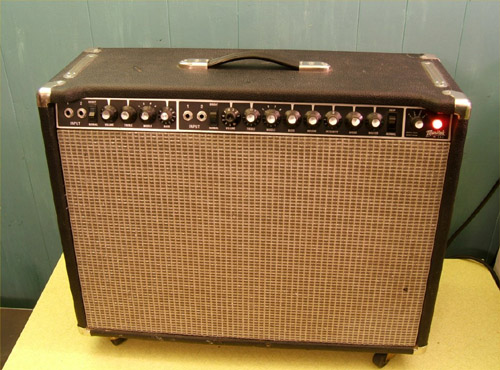
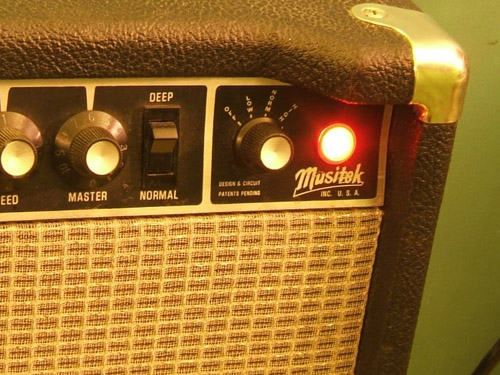
I recently saw this extremely rare amp offered on ebay  – a 1974 Musitek combo amp that looks very similar to the “Dire Straits” amp – the Music Man 130 HD 212.

1974 Musitek amp
1974 Musitek amp

In fact Musitek was one of the names  under which the very first amps were produced before the company was renamed to Music Man (see this article for more info on Music Man amps). As this was the first and only time I have ever seen such an early model, I want to feature it with this article.

The overall control layout was already identical to the later Music Man amp. The only difference I can see is a rotary switch with the positions ‘Off – Low – Normal – High’ at the position where normally the power switch is located. The later switch also allows  a low and high power position, but not the third ‘Normal’ mode.

Rotary switch insteasd of the power toggle switch

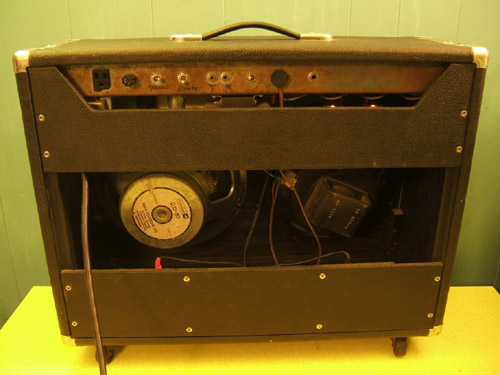
The rear panel looks very different from the Music Man version – almost like a  self-labelled prototype (which possibly is the case here – or there was originally a proper panel which is missing on the pictured amp).

The 12AX7 phase inverter tube and the Accutronics reverb tank seems to be the same as they were later. Note that the Celestion speaker is not original. The other one is a 1974 Alnico speaker by Eminence, however with a smaller magnet than the model used in the Music Man.

rear view (left speaker non original)
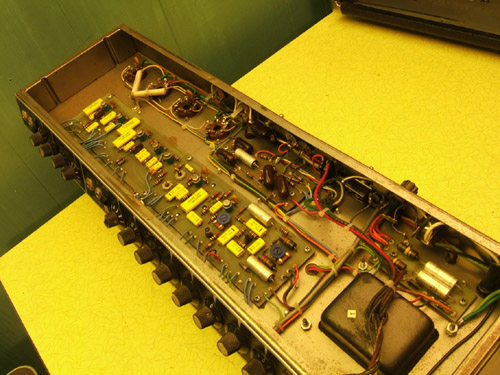
The inside looks similar to the Music Man

How to apply a waterslide decal to a guitar

I recently put one of these waterslide Fender decals on one of my guitars, which is basically an easy job that does not take very long. However, I remembered that I heard of even a luthier who got big problems with it. The mistake he made was that he left the decal too long in the water. If the decal loosens from the paper and swims around in the water, you are lost. So here is in very short how to do it:

1. Sometimes you must cut out the decal first with a pair of scissors. Normally – like with the “official” stuff from Fender – this is not necessary.

2. Put the decal into water and leave it there just a few seconds. Do not wait until it starts to loosen.

3. Take it out of the water and wait for some time – something like 1 – 4 minutes – until the decal starts to loosen. Try very carefully to move it on the paper to check if it has loosended everywhere.

4. Simply slide it directly from the paper to the position you want it to be on your guitar. The surface must be smooth by the way, which means a clean and dry laquered surface.

5. If there are wrinkles, try carefully to smooth it with a wet finger. Normally it can be moved for some time on the guitar surface.

6. Carefully wipe with a soft cloth over the decal to remove any water. Do this very lightly so that you do not destroy the decal.

7. Wait until it has dried.

8. If there are any small bubbles (which is normall not the case) you can use a needle to open these.

waterslide-small

That’s it. Again, the important trick is to take it out of the water and then wait until it starts to loosen, never leave it in the water so long.