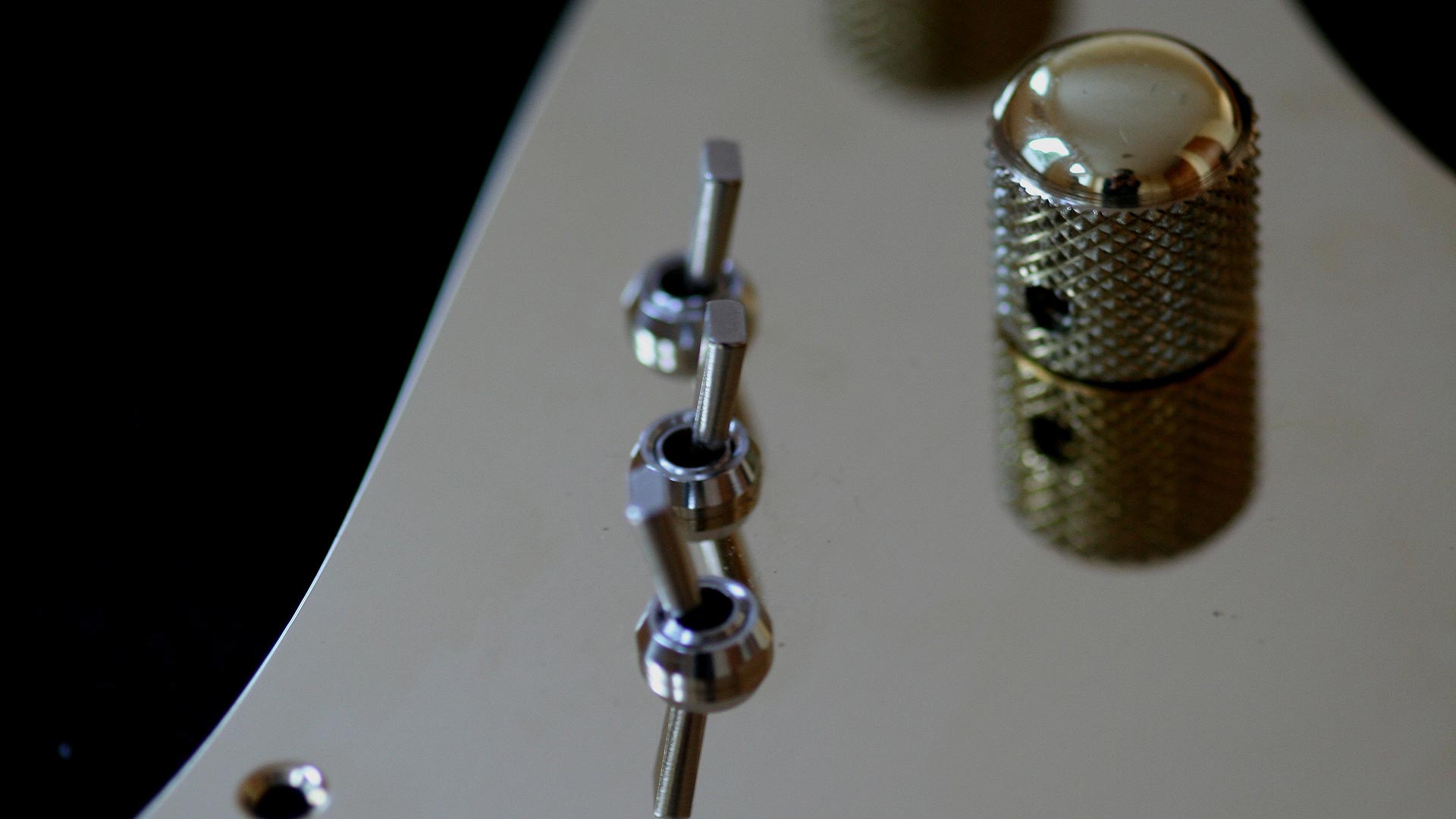
Mark Knopfler’s Grosh Electrajet

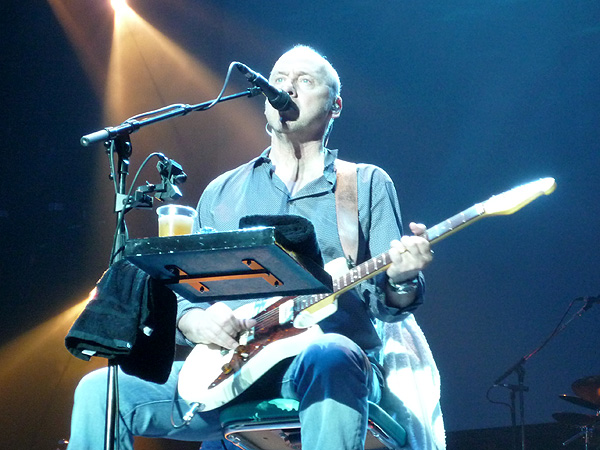
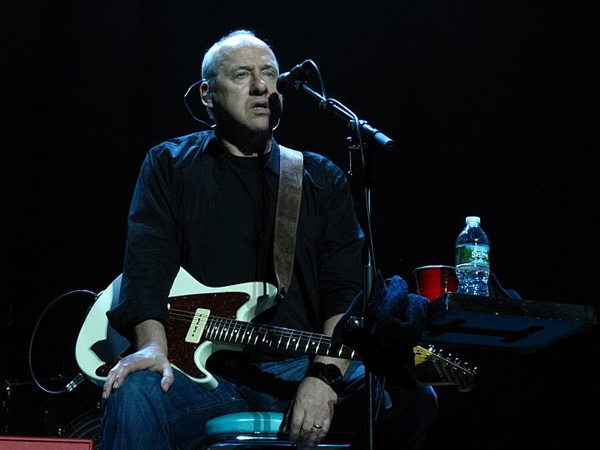
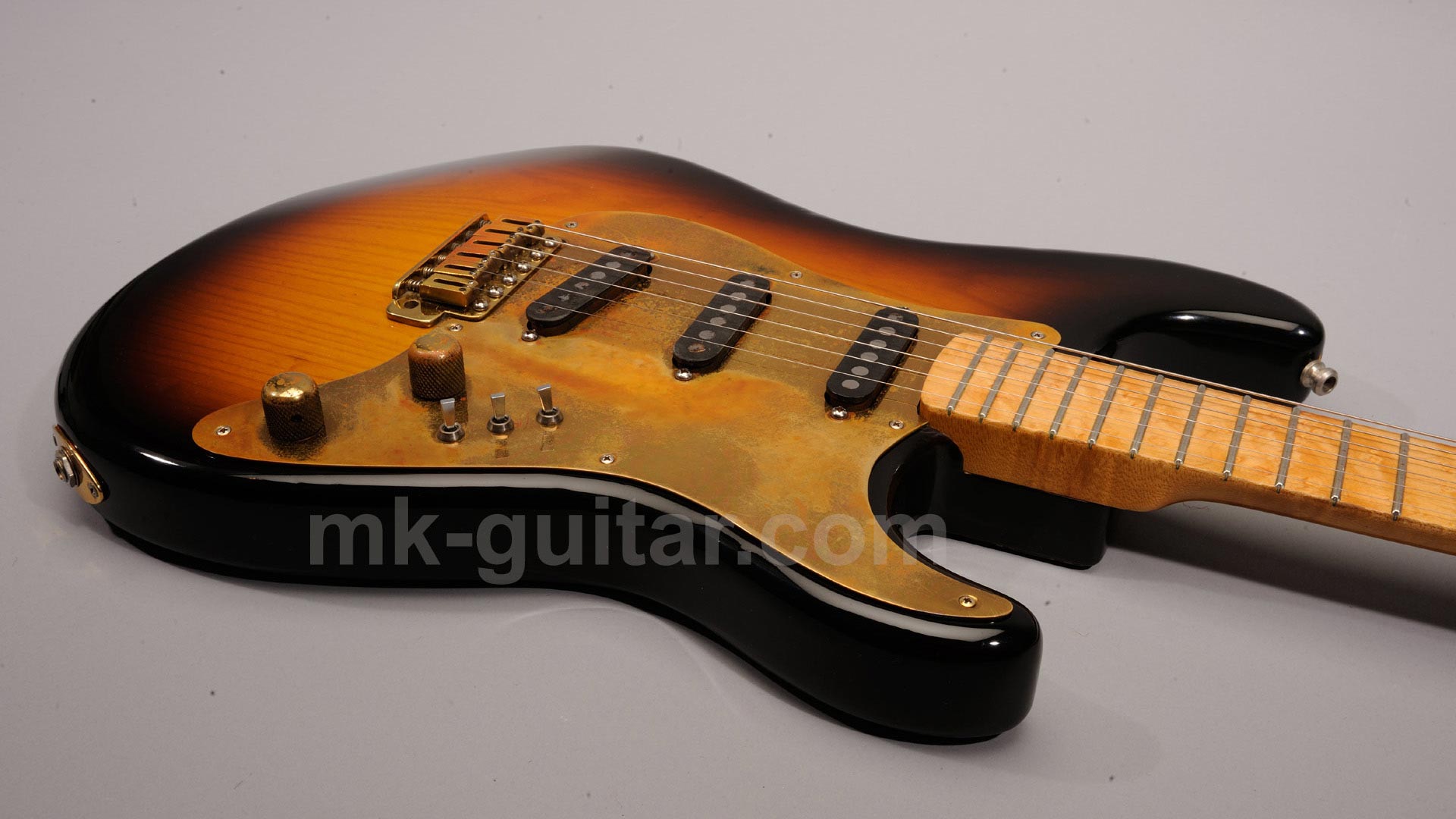
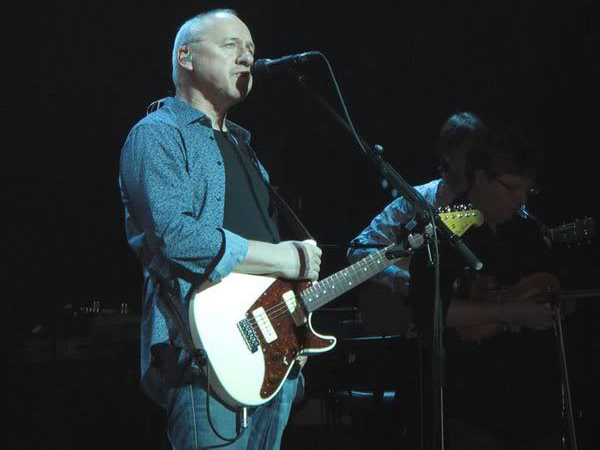
Visitors of Mark Knopfler’s latest Get Lucky tour might have wondered about one of Knopfler’s new guitars which he used on stage for the last song each night – Piper to the End. This song features  (live and studio) the Electrajet built by Luthier Don Grosh.

Don Grosh started his company Grosh Guitars in 1993, “with the singular goal of producing the world’s finest custom electric guitars and basses” (quote Grosh website). Each guitar is built from high-quality materials and parts by a small team of experienced luthiers under control and direction of Don Grosh himself. The product range covers models with both Fender or Gibson influence.

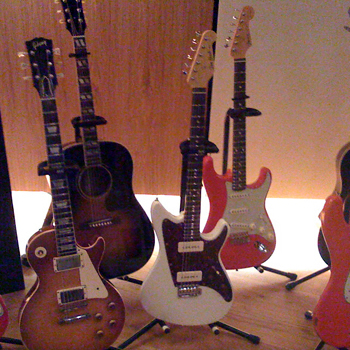
Mark’s guitar is the Electrajet, a Fenderish design which looks like a blend between a Stratocaster and a Jaguar or a Jazzmaster.
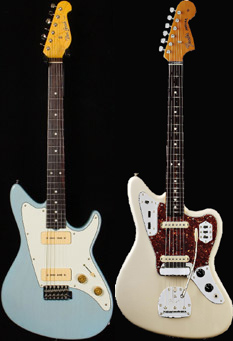
The Electrajet and a Fender Jaguar

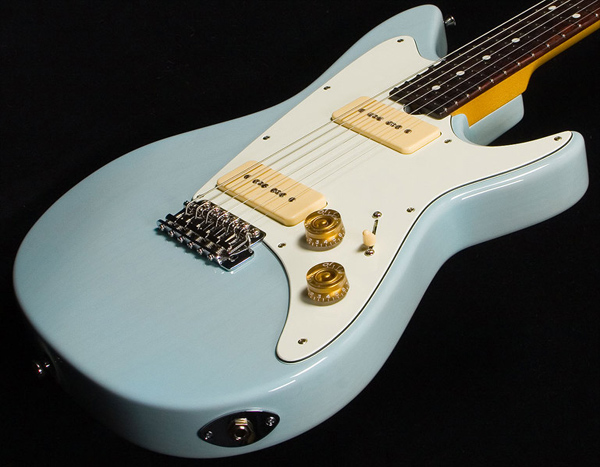
The Electrajet normally has an alder body, although ash or mahogany are optional. Grosh uses only hand-selected (“tap-tone matched”) old-growth tone woods. Unfortunately at the moment there is no information on the details of Mark’s guitar but it does not seem to differ much from the standard configuration except the brown tortoise pickguard instead of the standard one in aged white. The neck is maple with a rosewood fingerboard (brazilian rosewood is available at a 400$ extra charge). The tremolo system is a vintage-style Gotoh or Wilkinson Stratocaster bridge, while the jack plate seems to be adopted from the Telecaster.

The pick-ups are two handcrafted P90 – manufactured by Grosh, or optionally by Fralin. The original P90 is a Gibson single coil pick-up which has a warmer and fatter sound than a Fender single coil like in the Stratocaster.
Knopfler’s Electrajet seems to be in aged white. All Grosh guitars feature a hand-rubbed ultrathin nitrocellulose laquer finish which allows the wood to “breathe”.

The Electrajet is priced at $ 2,950 (base price, additional costs for optional features) for the custom version, or at $ 2,000 for a standard version. A detailed list of the differences between both and much more information on the Electrajet can be found on the Grosh website.

I can’t tell whether Mark used the Electrajet for other songs than Piper To the End. Here he played the bridge pick-up. I had the impression it did not went through his Reinhardt amps but through the Tone King Imperial. The sound was sharp (because of the bridge pick-up) with some warm distortion.

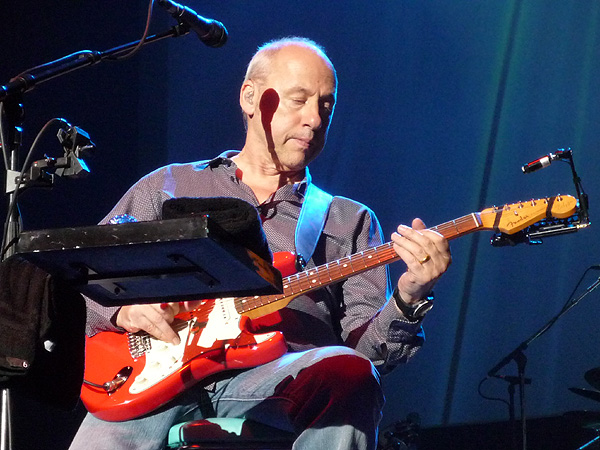
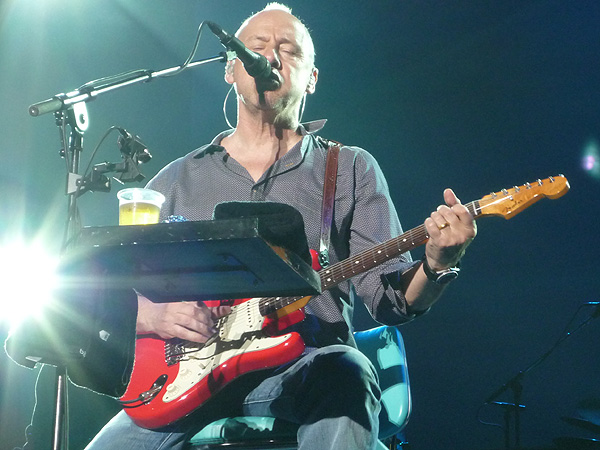
Below are some pictures from the recent tour which show Mark with the Electrajet.
The different Mark Knopfler signature Strats used on the Get Lucky tour

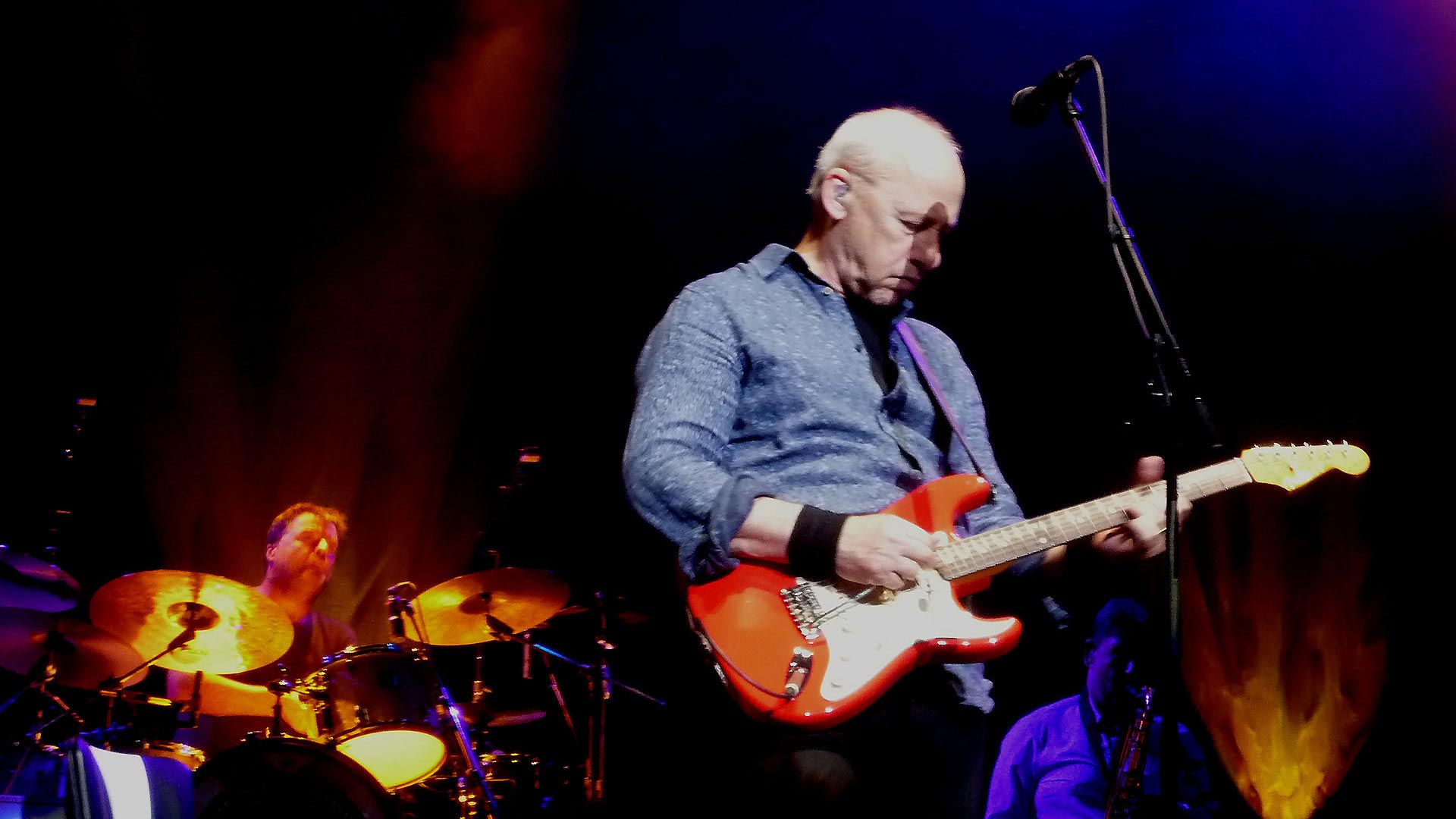
After seeing Mark Knopfler live on  the recent Get Lucky tour I can confirm that he plays different MK Signature Stratocasters on stage (compare the post on Guitars on the get Lucky tour). In Oberhausen und Amsterdam he seemed to play four different red MK Strats:

#1 – on Border Reiver

This one is tuned to Eb which of course does not mean an open tuning but one half note lower than standard tuning, something Jimi Hendrix or Stevie Ray Vaughn did to get a fatter sound without having trouble with playing techniques like string bending.

still looking for good picture

#2 – on What it is & Sailing to Philadelphia

Just like on the last tour, he probably has 010 string gauge on this one. Serial No is SE 00000 (confirmed for 2008 tour)

still looking for good picture

#3 – on outro of Romeo & Juliet and on Sultans of Swing

Probably with 009 string gauge again (confirmed for the Kill to get Crimson tour), with a wireless camera mounted on headstock. This one has a comparatively light rosewood fingerboard. On the 2008 tour he played these two songs on Glenn Worf’s MK signature Strat, which has a lighter, more orange colour. This might be the same guitar again.

Romeo & Sultans: Glenn Worf's guitar?

#4 on So far Away

On some gigs he played the ’54 Stratocaster, but seems to use another MK signature with heavy strings (wound g string) now. Easily to recognize on pictures because of the narrow guitar strap.

So far Away

One of Mark’s signature  Strats has the serial no SE 00001, but I cannot tell for sure which of the four guitars this is. The one on So far away has a nice slightly flamed headstockk, but the flame/grain pattern seems to be different than on the 00001 Strat. Maybe it is the one on Border reiver?

I am looking for good pictures of guitars   #1 and # 2 to contrast them all here. If you have any, please send them to me so that I can put them into this post.

And if you wonder where I got the information about the guitars of the 2008 tour from, check out this video in case you don’t already know it:

Which songs of the Get Lucky tour are played with the Tone King Imperial? And what was the amp setting?

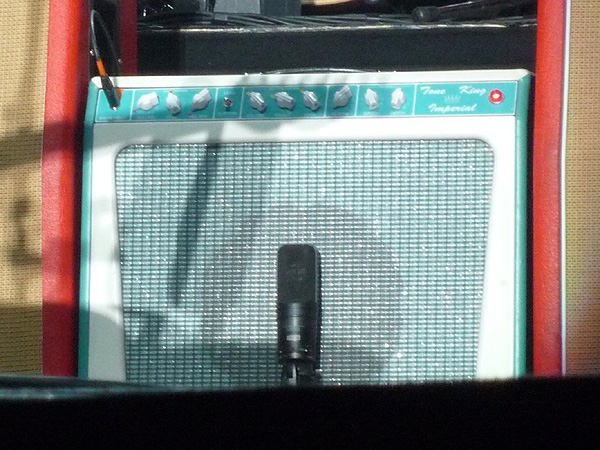
Visitors of the recent Get Lucky tour have seen the Tone King Imperial on stage again, located between two red Marshall cabs just like on the previous tours. I had ideal seats for the two concerts I have been to (Oberhausen and Amsterdam) and tried to make out for which songs Tone King was used, actually by trying to hear if the sound comes from the Marshall cab or from the Tone King.

It seems the Tone King was used on Donnegan’s gone and Piper to the End in Amsterdam (they did not play Donnegan’s gone in Oberhausen). By the  way , on the last tour (Kill to get Crimson) it was used on Cannibals, True love will never fade, Our Shangri-la, and Postcards from Paraguay.

Here is a picture of the amp settings in Amsterdam:

I guess the clean channel (right) was for Donnegan’s gone,  while the hotther left channel might be used for Piper to the End.

Of course I am not 100% sure, and the amp might have been used on other song’s too. If you can add some info, please do so with the comment function.

Some new thoughts on the Ernie Ball volume pedal

On the recent Get Lucky tour I became aware of a little technical detail I had never paid attention to before: I was sure that the guitar cable coming from the guitar would first go into the Ernie Ball volume pedal and then back to the area on the right side behind the stage where Mark Knopfler’s effect rack and amps are placed. Instead, I observed that a long cable leads directly from the guitar to where the amps are. In other words, the input amp of the effect rack (or some other) seems to be the first part in the signal chain. Here the signal is boosted to line level, then (before or after the other effects in the rack) it seems to go back to the volume pedal in the front area on stage, and back to the effect rack again from where it runs to the amps.

I always wondered why Mark’s volume pedal behaves different than the Ernie Ball pedals  I have tried out (the response curve seems to be totally different, see here for more). Maybe Mark’s pedal really has a different poti (like some rumours say), or it just reacts differently because it works on a much higher signal level (after the first gain stage in the effect rack the signal becomes “active”, which means more level and a lower impedance). Theoretically it is also possible that Mark uses the version for line levels of the Ernie Ball pedal, which has a 25 kOhms poti instead of the 250 kOhms of the standard version.

I tried my pedal with a low impedance signal to see if it makes any difference: it did not, but I could not test with a higher level yet.

Another consequence of this signal path is that the long first guitar cable surely changes the colour of the tone. The longer a cable is, the higher its capacity which means it moves down the position of the pick-ups resonance frequency peak. It acts like a small capacitor put into the circuit. This way the cables capacity can easily shift the resonance peak of a standard Fender pickup (normally at about 6 kHz) to something like 3 or 4 kHz, which means that glassy high end at 6 kHz is reduced and the “presence” frequencies at 3-4 kHz are boosted.

Mark Knopfler – Guitars on the Get Lucky tour 2010

The US leg of Mark Knopfler’s 2010 Get Lucky tour is over, and we in Europe are looking forward to the next part. Due to the new recording policy on all MK concerts,  there seem to be less videos on youtube than we had the years before, but still we have some 🙂 On the base of mainly these videos I put together a list of the guitars Mark has used on the different songs on this tour so far:

Red MK Signature Fender  Strat(s)

Of course he played his signature model, and probably more than just one. He played it on:

Border Reiver, What it is (not confirmed) , Sailing to Philadelphia (not confirmed), Romeo & Juliet (outro solo), Sultans of Swing

The guitar on Border Reiver is tuned to Eb (one half tone lower than standard tuning). On the 2008 tour he played one Strat with 010 strings on What it is and Sailing to Philadelphia, and another one (owned by Glenn Worf) with 009s on Sultans of Swing and Romeo & Juliet, might be similiar on this tour.

Gibson Les Paul

The following songs seem to be the ’58 Les Paul. I can’t tell if the ’59 was also used.

Why Aye Man, Hill Farmer Blues, Cleaning my Gun, Speedway at Nazareth, Brothers in Arms

Fender  ’54 Stratocaster

So far away

I first listed So far away for the MK Signature Strat, because of this video (bad quality, red or sunburst Strat?) but on all other ones I have seen so far it it the sunburst ’54 Strat.

Pensa

Telegraph Road (2nd part)

National Style-o

Romeo & Juliet, Telegraph Road (part 1 – until “three lanes moving slow”)

Don Grosh Electrajet

A rather new addition to Mark Knopfler’s collection.

Piper to the End

Martin 0040S

The Ragpicker signature model

Get Lucky, Marbletown

Danelectro

Tuned to open E, slide

Donnegan’s gone

(No information yet)

I cannot tell which guitars he played on the following songs. If you have been to the US tour or know more from other sources, please use the comment function to let us know.

Prairie Wedding, Monteleone, Remembrance Day, Coyote

Dire Straits – Brothers in Arms – Cover by Ingo Raven

This week-end I found time again to record another cover version – Brothers in Arms. After Six Blade Knife and Wild West End, this is the third video I put some additional effort into, which means I did not record the  audio with the microphone of the camcorder but with the gear in our homerecording studio. Nevertheless it should be considered rather as “live video” and not as studio recording because I played the  guitar plus the vocals in one complete live take – without any overdubs and without correcting little mistakes to leave it in a more authentic state.

This time I recorded four takes all in all and then decided which one to take. The backing tracks were done some time ago – regular readers might remember the blog article about recording the acoustic guitar (my Gibson MK-81) and another one where I jammed to it and played a few solos.

The backing track is available here.

Recording gear

I recorded all audio with Cubase and a Creamware Scope system (now by Sonic Core) with which I also mixed the final tracks. The Hammond B3 emulation is also from the Scope system, and so is the reverb and all other effects (except a bit spring reverb from the guitar amp, and a sleight delay from the MXR analog delay). The drums are from Native Instrument’s Battery, a VST plug-in in Cubase.

Maybe you are wondering how I synced the Cubase audio to the digital video file: in fact I did not sync them at all. Instead I recorded the audio in Cubase,  and filmed myself while playing the guitar plus vocals. I later imported the video file and the mixed audio track into a friend’s Adobe Premiere. Here I visually aligned both tracks so that the waveform of the master audio track and the audio of the video file start simultaneously – at high zoom this is pretty easy to achieve. I found that for some reason both tracks do hardly drift apart over a time of just a few minutes. Then I simply muted the audio of the video file so that you hear the master audio only – that’s it. The same I did with the second video file.

Gear used here – signal chain

Gibson Les Paul Custom ’74 (10s strings)
Morley Volume pedal
MXR Analog Delay
Music Man HD 130 212
Shure SM 57

Some notes on how to play it and how to get the sound – dynamics are the key

I guess there are a zillion tabs around that tell you which notes to play (I myself never play or learn anything from using tabs, by the way), so I am not going to talk about this stuff here again. Besides I improvise a lot here: I found that as long as you stay in the G#m scale you can play more or less what you feel to and it sounds alright, the rest are all those licks I remember hearing in one of the many version Mark Knopfler did of this song. Each time I play it, I play it totally different, I never stick to a particular version.

What however seems important to me is the use of dynamics. What I mean is to remember that good music consists of loud notes which are contrasted with low, subtle notes. Many players I see on youtube seem to play everything rather loud. The problem is that when you start a song like Brothers in Arms and hit all those first notes at – let’s say – 80% percent of maximum strength, you cannot go really higher to highlight other notes. If you however start at rather 20% – which I am doing here – you have more to add later. Besides, the sound will be completely different. Be aware that Youtube also compresses the dynamics, so in the room I played with even more contrast between loud and quiet notes than you are hearing here. Similarly, something like the original Sultans of Swing is played with a huge dynamics range (which is later reduced technically for some other reasons) and this causes a huge sound difference compared with playing with a small dynmaics range. I guess I might come back to this topic with a dedicated future blog article.

Mark Knopfler – You can’t beat the house – Variations of the standard blues scheme

The song You can’t beat the House of Mark Knopfler’s latest album Get Lucky is a traditional sounding blues song, reminding of some Chicago blues. However, something in its chord scheme sounds somewhat surprising and fresh, so I had a closer look at the chords and the structure of the song.

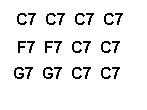
You can’t beat the house is based on a standard 12-bars blues scheme. Of course there is not only one blues scheme, but many common variations. If you try to break it down to the very basics, the following 12-bar scheme seems to be the purest blues scheme (here in the key of C major):

The standard blues scheme

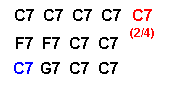
Compared with this, the first verse of You can’t beat the house runs over the following scheme:

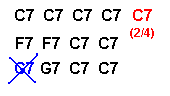
The scheme of verse 1

Everything is quite normal up to bar 5, where an additional 2/4 bar (red) is inserted before the change to the subdominant (IV) chord, the F7. This chord goes together with the line of the lyrics which says  “you can’t beat the house”. It is totally unexpected and thus has a surprising effect. Generally, inserting 2/4 bars into a 4/4 song is one of THE typical elements of Mark Knopfler’s songwriting, a topic to be covered with a future blog article.

The second change to the original scheme affects the 9th bar of the original scheme: the first G7 (change to the dominant chord) is substituted with a C7 (blue colour) here.

The second verse and the last verses are almost identical to the first with one exception, the 9th bar is left out:

One bar is omitted in verses 2 and 3

As you see, we don’t have a 12-bar scheme anymore but a 12.5-bar scheme in the first and an 11.5-bar scheme.

The solos are over the standard blues scheme as in the first figure. Just to make it complete, the bridge (from 2:00 to 2:18) is just over a C chord.

Thomas Schwarze / Ingo Raven – Jamming on Stratocaster and Telecaster

A few days ago I jammed a bit with a friend of mine – Thomas Schwarze – in our little home studio. Thomas is a great guitar player and also plays fingerstyle, using a technique similar to the MK style. Our first idea was to play “something” and upload it to youtube. We tried out a few tunes and then attempted to play a rather complex tune – a song I wrote some time ago and recently started to arrange for a proper recording. Unfortunately it did not really happen  with this song this day – too many parts and details to get it done properly in a little jam – so we decided to drop the idea of the youtube upload, and just jammed over some of the chord progressions of this song. For some reason we simply let the camera run, and also the audio recording software.

When we were watching the result we thought it was not that bad, so we finally uploaded it last week. Most comments on youtube so far were favourable, some people seemed to enjoy the relaxed mood of the tune. For this reason I thought some of you also might want to watch it, so here it is.

The gear  used

The red Strat I am playing is a “Parts-o-caster”, it is something like a clone of Mark Knopfler’s red maple-neck Strat of early Dire Straits days, consisting of an old Fender neck with a (non-original) laminated maple board, a Japanese vintage body, and a vintage Squier pickguard loaded with the US vintage replica pick-ups of those first Squiers.

The amp was a Music Man 212 HD 130, mic’ed with a Shure SM 57. Effects are a Morley volume pedal and the green MXR analog delay.

Thomas is playing a Fender Telecaster from the early 70ies, a beautiful guitar that always sounds great, also played through a Music Man amp (a 65-112), mic’ed with an Audio Technica AT 4050.

By the way, the chord progression is

E D A E (repeat)
C#m, B, A, G#m, F#m, E, A, E

Hope you will enjoy 🙂

Dire Straits – Wild West End – Cover by Ingo Raven

Wild West End from Dire Straits’ first album has always been one of my all-time favourite songs, so it is no wonder that it is one of the songs I recently started to practice a bit. Of course you will never come to a point where you think that you really can play it (at least not the way you feel it should be played like), but a few days ago I nevertheless recorded and filmed me playing this  song,  to capture its current state so to say (see video below).

I played the lead guitar together with the vocals live in one take, over a self-produced backing track (available here).

Here is a “little secret” about the way I filmed the video (before some Sherlock Holmes might notice it anyway): As I have only one camcorder, I cannot film different views simultaneously. For this reason I mimic’ed the lead guitar in a second take for the close-up scenes (I thought some of you might like to see some details what the fingers are doing). Same for the rhythm guitar which I did not film when recording it for the backing track (it was in fact the same guitar shown here, a beautiful blonde Fender Telecaster).

The  gear I used

The lead guitar is  a US Fender Vintage Stratocaster ’62 which lost its finish some years ago – played into a Music Man 212 HD 130, mic’ed with a Shure SM 57.  Effects are a Morley volume pedal and the green MXR analog delay. I added some EQ’ing, a limiter (!) and some reverb in the mix (the reverb of the Music Man was also on). That long stereo echo at the end of the intro was also from the desk (the “desk” and the effects are all software in my case).

The rhythm guitar was tuned to Open A and capo’ed at the 5th fret (thus open D). I played it directly into the desk and added a bit of EQ and reverb. As said, it is a wonderful Telecaster, played with both pick-ups on, all controls up.

But now, here is the video, I hope you will enjoy it.